Another Lasker Prize at PennMed: Dr. Armstrong
of Physiology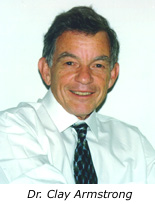
Dr. Clay M. Armstrong, professor of physiology at the School of Medicine
since 1975, will share the 1999 Albert Lasker Basic Medical Research Award
from the Albert and Mary Lasker Foundation--the second year in a row that
PennMed faculty*
have been among the winners in a program often called a Nobel Prize "predictor"
because of the high number of Lasker Prize winners (61 at last count) who
have gone on to Stockholm.**
Dr. Armstrong will receive the award at a luncheon in New York City on
October 1. Another of the six scholars to be honored then is Dr. Seymour
S. Kety, C '36, M'40, who taught at Penn from 1943-61--initially in pharmacology,
but later in clinical psychology, before moving to Harvard where he is now
professor emeritus of neuroscience. Dr. Kety's Lasker Award for Special
Achievement in Medical Science recognizes lifetime achievements, including
discoveries in blood flow and in genetics, and "visionary leadership
in mental health that ushered psychiatry into the molecular era."
Dr. Armstrong, a member of the National Academy of Sciences, is cited
along with the University of Washington's Dr. Bertil Hille and Rockefeller
University's Dr. Roderick MacKinnon, for "elucidating the functional
and structural architecture of ion channel proteins, which govern the electrical
potential of membranes throughout nature, thereby generating nerve impulses,
and controlling muscle contraction, cardiac rhythm, and hormone secretion."
Dr. Armstrong's work unveiled the mechanisms governing the behavior of
ion channels, a PennMed biographical sketch adds. "Since the 19th century,
scientists have known that nerve impulses were transmitted electrically.
Exactly how they were propagated throughout the body, however, was still
mysterious. During approximately the same era, engineers working on the
first trans-Atlantic cables found that electronic signals would fade and
be lost without the use of booster stations along the way. What Armstrong
discovered years later was precisely how ion channels function as the nervous
system's booster stations, responsible for receiving and reproducing signals
as they travel along nerve fibers."
Many important drugs act by blocking ion channels--e.g., local anaesthetics
and calcium channel blockers, which are used to restore the normal rhythms
of the heart--and Dr. Armstrong's research has contributed to the understanding
of the mechanisms by which drugs interact with ion channels.
In the 1970s he gained fundamental insights into the ion-channel structures
responsible for sensing an incoming electrical signal, for opening the gate
that controls ion passage, and for closing it. He then proposed the existence
of a positively charged helix for detecting the "gating" of the
channel, and he first succeeded (with Francisco Bezanilla, now professor
of physiology at UCLA) in measuring the current caused by the movement of
that charged helix. He also postulated a 'ball and chain' mechanism for
inactivation of channels, in which a globular peptide attached to an amino
acid chain can block the channel by becoming lodged in its inner mouth.
In all of these areas, Dr. Armstrong is credited with anticipating recent
structural insights gained from molecular biology and X-ray crystallography.
Dr. Armstrong took his B.A. with honors in 1956 from Rice University
and his M.D. in 1960 from Washington University/St. Louis, followed by a
research fellowship in neurology there. He then did postdoctoral work at
the NIH and at the University College London, where he worked with A.F.
Huxley. He was an assistant professor of physiology at Duke from 1966 until
1969, when he joined Rochester as associate professor. Named "Teacher
of the Year" by Rochester's freshman medical class in 1973, he was
promoted to full professor in 1974. He joined Penn in 1975--the year he
also won the Biophysical Society's K.S. Cole Award. Among other honors he
has since headed the Society of General Physiologists (1985-86); been elected
to the National Academy (1987); and shared Columbia's Louisa Gross Horwitz
Prize (1996).
__________
* For the 1998 Lasker Clinical Medical Research Awards
to Dr. Peter C. Nowell and Dr. Alfred G. Knudson, Jr., see Almanac
September 22, 1998.
** Two of the 61 are Dr. Michael S. Brown, C '62, M
'66 (Almanac October 22, 1985); and Dr. Stanley B. Prusiner, C '64,
M '68 (Almanac
October 7, 1997). |
Annenberg School's 40th: Tonight and Tomorrow
The Annenberg School for Communication will celebrate its 40th anniversary--and
the opening of its new Annenberg Public Policy Center--with a gala that
starts at 7 p.m. tonight with the eighth annual Walter and Leonore Annenberg
Distinguished Lecture in Communication, given in the Zellerbach Theater
by Duncan Kenworthy--filmaker, producer, and 1973 alumnus of the School.
A 9 a.m. address by New Jersey Governor Christine Todd Whitman will open
tomorrow's events, which include the dedication of the Annenberg Public
Policy Center at 11 a.m.; a speech by NBC News anchor Tom Brokaw at 11:45;
and one at 6 p.m. by David Halberstam, Pulitzer Prize-winning journalist
and author.
During the afternoon there will be panel sessions including Presidential
Election Campaigns: Past and Future, moderated by David Eisenhower,
and five others led by members of the Annenberg School: Television and
Popular Culture, by Associate Professor of Communication Barbie Zelizer;
Media and the Dialogue of Democracy, by Associate Professor Vincent
E. Price; Health Communication, Professor Robert C. Hornik; Information
and Society, by Professor Joseph Turow; and Media and the Developing
Mind by Senior Research Investigator Amy Jordan. |
On Parental Notification in Alcohol and Drug Cases
Under recent changes in the federal Family Educational Rights and Privacy
Act, colleges and universities are now allowed to report violations of drinking
and drug laws to the parents of minors under 21, and to disclose disciplinary
sanctions for those found responsible for "crimes of violence"
and "non-forcible sexual offenses."
Published For Comment in
this issue is a report of a committee headed by Dr. Richard Beeman,
dean of The College, which proposes Penn guidelines for notifying parents
of drug and alcohol-related violations under the revised law. President
Rodin and Provost Barchi ask feedback by October 15, and will issue
a decision after campus-wide discussion including a UA Forum.
The committee will reconvene shortly to examine the other instances when
parents may be notified. |

