
 |
|
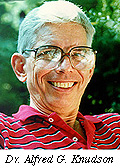 Lasker Prize: Drs. Nowell, Knudson
 Two members of the School of Medicine share this year's Albert Lasker
Clinical Medical Research Award, the prize described as the "American
Nobel": Dr. Peter C. Nowell, professor of pathology and laboratory
medicine, and Dr. Alfred G. Knudson, Jr., adjunct professor of human genetics
and pediatrics.
Two members of the School of Medicine share this year's Albert Lasker
Clinical Medical Research Award, the prize described as the "American
Nobel": Dr. Peter C. Nowell, professor of pathology and laboratory
medicine, and Dr. Alfred G. Knudson, Jr., adjunct professor of human genetics
and pediatrics.
Along with Dr. Janet D. Rowley of Chicago, they were chosen for "incisive studies in patient-oriented research that paved the way for identifying genetic alterations that cause cancer in humans and that allow for cancer diagnosis in patients at the molecular level, " the Albert and Mary Lasker Foundation announced.
Dr. Nowell, who has been on the faculty here since 1956, is renowned as the discoverer of the "Philadelphia chromosome." In 1960, just four years after the precise number of human chromosomes had been fixed at 46 and at a time when no relationship between cancer and chromosomes was known to exist, he recalls "diddling around with leukemia cells in a glass dish" and finding that a plant substance made cells divide. Staining them to make the cell division visible, he then collaborated with the late Dr. David Hungerford in experiments that showed patients suffering from chronic myelogenous leukemia (CML) had a defect in Chromosome 22-a small cell to begin with, but abnormally so in CML patients. "At a time when the idea that cancer had a genetic basis was widely disbelieved," said the Lasker Foundation, "Nowell's results provided the first clear evidence that a particular genetic defect in a single chromosome can lead to a population or clone of identical cells that accumulate in numbers to form a deadly malignancy." (Dr. Janet Rowley was later to find that a piece of the chromosome had broken off.)
Dr. Knudson, who has been an adjunct faculty member here since 1976, when he joined the Fox Chase Cancer Center, is known for a "two-hit" hypothesis on the origin of cancer, based on an analysis of retinoblastoma, a tumor that occurs in both hereditary and non-hereditary form. Ahead of his time and ahead of his own hard data, the Foundation said, he hypothesized that some genes' normal role in life is to behave as anti-cancer or tumor-suppressor genes that keep cell division under healthy control. In 1976 his mathematically-based hypothesis was proved when he and others showed that some patients with hereditary retinoblastoma are missing a segment of Chromosome 13 in all of their cells.
Both scientists are members of the National Academy of Sciences and the American Philosophical Society, and both hold most of the major scientific awards given in their fields. Dr. Knudson, who began at Fox Chase as the director of its Institute for Cancer Research and later served as its president (1980-82), is now Fox Chase Distinguished Scientist there. He is an alumnus of CalTech who took his M.D. and Ph.D. from Columbia and spent his early career at the City of Hope, SUNY Buffalo, and University of Texas/Houston before coming to Philadelphia in 1976.
Dr. Nowell, a Wesleyan University alumnus who took his M.D. here in 1952, has been on the PennMed faculty since 1956, when he started as an instructor. He rose to full professor in 1964, and in 1964 was named Gaylord P. and Mary Louise Harnwell Professor of Pathology and Laboratory Medicine in 1990. He received the Lindback Award in 1967 and his department has named a teaching award in his honor. Among his awards for research are the Parke Davis Award and the Rous-Whipple Award of the American Association of Pathologists; the La Madonnina Award of Milan; the Passano Foundation Award; an Outstanding Investigator Grant from the NIH; the Robert de Villiers Award of the Leukemia Society of America; and the Mott Prize of the General Motors Cancer Research Foundation.
He helped spearhead major curricular changes in medicine in the 1970s,
and in the following decade he chaired the committee that reviewed and extended
them. He was the organizer and first director of the University of Pennsylvania
Cancer Center and is currently its deputy director. In addition to serving
on numerous Medical School committees he has served as Moderator of the
University Council (1975-77).
Human Resources Changes
News in Brief
Human Resources Changes
Vice President for Human Resources John J. Heuer has announced the outsourcing of some benefits services including medical, prescription drug, dental and life insurance as well as the spending accounts.
"Other Penn benefit programs-retierement plan, tax-deferred annuities, tuition, paid time off, sick lieave and other types of leave-will continue to be administered by the staff of Penn's Benefit Office," Mr. Heuer said.
Currently the Benefits staff is comprised of 13 full-time and seven temporary employees. "Since the initial discussion with Hewitt, Human Resources has not filled the vacant positions to minimize the impact on current benefits office staff. Roles may change and some employees will be given the opportunity to transition to other positions within Human Resources or elsewhere at Penn," said Mr. Heuer. (See his memorandum to the Penn community)
Mr. Heuer also announced a new
Personal Financial Planning Program.
Women's Studies at 25
All members of the University are invited to this week's events celebrating the 25th anniversary of the Women's Studies Program at Penn:
- Thursday, September 24, 4:30 p.m. in Logan Hall 17: Dr. Catherine Stimpson, Graduate Dean of NYU, gives the keynote address, "Mary, Martha, or Ally McBeal?: Who and Where is Women's Studies?" A reception follows.
- Friday, September 25, 9 a.m. to 5 p.m., ten panel discussions (some of them concurrent) at Bennett Hall and Logan Hall, with luncheon at noon and reception at 5 p.m.; for topics see September at Penn (in Almanac September 8) or the Women's Studies website, www.sas.upenn.edu/wstudies/.
Almanac, Vol. 45, No. 4, September 22, 1998
FRONT PAGE | CONTENTS | JOB-OPS | CRIMESTATS | BETWEEN ISSUES | SEPTEMBER at PENN | INSERT: STEERING COMMITTEE REPORTS AND COUNCIL BYLAWS