
 |
|
Bicentennial Class of '40 and Class of '42 Chairs: Dr. Filreis and Dr. Sugrue
Provost Robert Barchi has announced the award of endowed term chairs to Dr. Alan Filreis of English and to Dr. Thomas Sugrue of History. They will hold prestigious alumni-funded chairs that cut across school lines to recognize faculty who have made "significant contributions to scholarship and to undergraduate teaching."
For their fiftieth reunions, both the Bicentennial Class of 1940 and the Class of 1942 endowed term chairs that provide each holder with $10,000 a year for five years in discretionary research funds, which may be used for research assistance, travel or special equipment, extra support for library acquisitions in the holder's field of specialization, and resources to support publication of research and writing.
The two chairs rotate every five years among the four undergraduate schools. Since the chairs were last held by faculty in the School of Engineering and Applied Science, nominations were requested this year from Wharton, Nursing and SAS. A faculty committee chaired by Dr. John Quinn of Engineering reviewed the nominations and made their recommendations to the Provost.
Dr. Alan Filreis, professor of English, was awarded the Class of 1942 chair previously held by Dr. Kyle Vanderlick.
Dr. Thomas Sugrue, associate professor of history, takes the Bicentennial Class of 1940 Chair formerly held by Dr. Jan Van der Spiegel.
 About Dr. Sugrue:
Nominated by Dean Samuel Preston as one who "has risen to an important
position in 20th century American historiography at an unusually early stage
of his career while maintaining a deep commitment to undergraduate teaching,"
Dr. Sugrue came to Penn as a lecturer in 1991 and joined the standing faculty
the following year. Before and after his promotion to tenure in 1997, he
gathered awards for teaching and scholarship. In 1996, he won the Outstanding
Professor Award of Penn's Greek Council along with the Best Article Prize
of the Urban History Association and the President's Book Award of the Social
Science History Association. In 1997, he shared the Sidney Hillman Foundation
Award for a national teach-in with the labor movement and also won the Philip
Taft prize for Best Book in Labor History. And last year, he won the History
Undergraduate Advisory Board Teaching Award alongside a Bancroft Prize in
American History.
About Dr. Sugrue:
Nominated by Dean Samuel Preston as one who "has risen to an important
position in 20th century American historiography at an unusually early stage
of his career while maintaining a deep commitment to undergraduate teaching,"
Dr. Sugrue came to Penn as a lecturer in 1991 and joined the standing faculty
the following year. Before and after his promotion to tenure in 1997, he
gathered awards for teaching and scholarship. In 1996, he won the Outstanding
Professor Award of Penn's Greek Council along with the Best Article Prize
of the Urban History Association and the President's Book Award of the Social
Science History Association. In 1997, he shared the Sidney Hillman Foundation
Award for a national teach-in with the labor movement and also won the Philip
Taft prize for Best Book in Labor History. And last year, he won the History
Undergraduate Advisory Board Teaching Award alongside a Bancroft Prize in
American History.
The book that won prizes three years in a row is The Origins of the Urban Crisis: Race and Inequality in Postwar Detroit (Princeton 1996). His more recent work is as coeditor, with Dr. Michael Katz, of W.E.B. DuBois, Race and the City: The Philadelphia Negro and Its Legacy (Penn 1998), and he is now at work on Racial Integration and Its Critics in Twentieth-Century America, and is co-editor of a forthcoming special issue of the Budapest Quarterly Review called The Urban Crisis: Poverty and Inequality in America.
Dr. Sugrue took a B.A. from Columbia summa cum laude in 1984, and another, with honours, from Cambridge in 1986. He also earned an M.A. at Cambridge and an A.M. at Harvard, en route to his Ph.D. there in 1992. In 1990-91, before joining Penn, he was a research fellow at The Brookings Institution.
 About Dr. Filreis: The
new Class of 1942 Professor is an award-winning teacher (of the Lindback
in 1992, the Ira Abrams in 1995, and, last year, the designation Pennsylvania
Professor of the Year by the Carnegie Foundation/CASE). He is also called
"one of his generation's most important scholars and critics of American
modernist poetry of the period from the 1920s through the Cold War,"
in Dean Preston's nomination--which cites particularly his books on Wallace
Stevens that have overturned previous scholarship to show Stevens to be
deeply engaged in the political issues of his time. Dean Preston also says,
"In his integration of brilliant scholarship with unstinting devotion
to teaching and educational reform, Professor Filreis is without peer."
About Dr. Filreis: The
new Class of 1942 Professor is an award-winning teacher (of the Lindback
in 1992, the Ira Abrams in 1995, and, last year, the designation Pennsylvania
Professor of the Year by the Carnegie Foundation/CASE). He is also called
"one of his generation's most important scholars and critics of American
modernist poetry of the period from the 1920s through the Cold War,"
in Dean Preston's nomination--which cites particularly his books on Wallace
Stevens that have overturned previous scholarship to show Stevens to be
deeply engaged in the political issues of his time. Dean Preston also says,
"In his integration of brilliant scholarship with unstinting devotion
to teaching and educational reform, Professor Filreis is without peer."
Dr. Filreis came to Penn in 1985, a 1978 alumnus of Colgate with his Ph.D. from the University of Virginia. He was named the Esther K. & N. Mark Watkins Assistant Professor in the Humanities in 1988, and was promoted to tenure in 1991 and to full professor in 1995. In 1993-96, as undergraduate chair of English, he led a restructuring of the major that was widely praised by faculty and students alike, while also pioneering the use of listservs to extend discussion outside the classroom. Becoming master of Van Pelt College House in 1995 and chair of the Residential Faculty Council in 1996, he introduced programs using technology to provide academic services to students around-the-clock in their dorms--a major amenity of the College House System as now structured. As he left the mastership of Van Pelt, Dr. Filreis embarked on still another form of learning in action, as founding director of the Kelly Writers House, the first of Penn's two "hubs" organized around a common interest as a home base for residential and nonresidential students, faculty and staff. (The other is Civic House, organized around community service and led by Dr. Peter Conn.)
Dr. Filreis's Wallace Stevens and the Actual World (Princeton 1991) and Modernism from Right to Left: Wallace Stevens, the Thirties & Literary Radicalism (Cambridge 1994), will be followed shortly by The Fifties' Thirties: U.S. Poetry & Anticommunist Culture.
Wharton Teaching Awards
 |
 |
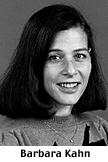
Top row: Dr.Kahn and Dr. Hitt won Hauck Awards, |
 |
 |
Bottom row: Dr. Allen the Anvil, and Dr. Tyson the Class of 1984 Award plus others |
Almanac, Vol. 45, No. 30, April 27, 1999
FRONT PAGE | CONTENTS | JOB-OPS | CRIMESTATS | TALK ABOUT TEACHING | BETWEEN ISSUES | MAY at PENN