|
Law School's Awards Professor Diver, known for his contributions to the school during his tenure as dean, took this same enthusiasm and commitment into the classroom--as was evident in the student evaluations which read in part, "…may be the best professor I've had in both my undergraduate and graduate experience," "…best teacher I have had in my schooling career. He makes me not only want to be a better lawyer, but a better person." And, "Every professor should be as clear, interesting, respectful, energetic and humorous as this one." Professor Diver will be leaving Penn to serve as the 14th President of Reed College (Almanac February 19). According to Dean Michael A. Fitts, "Colin will be greatly missed here at Penn Law School. He served as a very successful dean for a decade (the longest tenure of any Penn Law Dean since Jefferson Fordham). Since stepping down from the deanship, he has pursued teaching and scholarship with the same energy and dedication." The Colin S. Diver Distinguished Chair in Leadership was established in 1999 with contributions from alumni and friends of Penn Law. Professor Scheppele's largest class, Evidence, is a standard in the law curriculum, and this year her class filled the largest classroom at the school. Her signature approach to teaching this class involves working with transcripts of actual trials to give students a sense of how real-world evidence problems arise. This year, because of the 9/11 events, she used the transcript from the 2001 trial called the U.S. v. Osama bin Laden, a criminal case brought in New York City against four men accused of plotting and carrying out the bombing of American embassies in Kenya and Tanzania. Inspired by what she learned in editing down the transcript of this three-month trial, she went on in the spring term to develop a new course called Terrorism and Democracy, which looked at the history of terrorism around the world and the responses of other governments to it, before concentrating on the 9/11 attacks in the US and the legal responses that came after. "The students at Penn Law are terrific," Professor Scheppele said. "They are inspiring, and they appreciate courses that keep them in touch with what is happening in the world." She has also been involved in the College's experimental course "How Do You Know?," teaching a section on legal conceptions of evidence. Professor Skeel teaches in the areas of bankruptcy and corporation law. This year he taught Commercial Credit II, Corporations, and a Gambling and Speculation Seminar. He is known for his dynamic classes, the clarity of his teaching and his enthusiasm. Students have commented "Professor Skeel is exceptionally clear and effective in generating interest in what he speaks about in class;" "one of the best organized"; "stimulated a lot of interest in the subject"; and "Professor Skeel is terrific and made the class so interesting--especially by incorporating current events." He is the author of Debt's Dominion: A History of Bankruptcy Law in America, and a frequent commentator on NPR, in newspapers, and recently on Nightline.
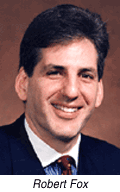
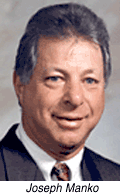
Joseph Manko and Robert Fox are the first recipients of the school's new Adjunct Teaching Award which was established this year. The Associate Dean determines the award based on student evaluations of courses. As experts in the field of environmental law, Professors Manko and Fox were able to provide students with special insights into their course, Introduction to Environmental Law, presenting theory and policy concepts while sharing real-world anecdotes about how environmental regulation works in practice. Students learned about the issues and requirements facing companies and regulators in evaluating and developing environmental policies and procedures, including the broad variety of enforcement actions. One student commented, "I thought they were fantastic instructors. The discussion very rarely lagged, and they always kept me interested in even the driest material." Another noted, "both obviously are passionate about the field and conveyed that passion well. Almanac, Vol. 48, No. 35, May 28, 2002 |
ISSUE HIGHLIGHTS: Tuesday,
|


 Colin
S. Diver, Charles
A. Heimbold Professor of Law and Economics, and the law dean from
1989-99, is the recipient of the A. Leo Levin Award for
excellence in an introductory course. The Award was determined
by the Associate Deans on the basis of teaching evaluations.
Colin
S. Diver, Charles
A. Heimbold Professor of Law and Economics, and the law dean from
1989-99, is the recipient of the A. Leo Levin Award for
excellence in an introductory course. The Award was determined
by the Associate Deans on the basis of teaching evaluations. Kim
Lane Scheppele,
professor of law, is the recipient of the Robert A. Gorman Award
for excellence in teaching. The Robert A. Gorman Award was established
this spring in honor of emeritus professor Robert A. Gorman, the
Kenneth W. Gemmill Professor of Law, who taught at the school
for more than 35 years until 2001. The Associate Dean determines
the award based on student evaluations of courses.
Kim
Lane Scheppele,
professor of law, is the recipient of the Robert A. Gorman Award
for excellence in teaching. The Robert A. Gorman Award was established
this spring in honor of emeritus professor Robert A. Gorman, the
Kenneth W. Gemmill Professor of Law, who taught at the school
for more than 35 years until 2001. The Associate Dean determines
the award based on student evaluations of courses. David
Skeel,
professor of law, was awarded the Harvey Levin Award for Teaching.
This is the second time for Professor Skeel, who received this
recognition in 1999 as well. The Award was named for alumnus Harvey
Levin (B.S. '55, L.L.D. '58), an anti-trust law specialist who
died in 1976 at the age of 43. It was established by his firm,
Schnader Harrison Segal & Lewis in 1978, to be awarded annually
to a faculty member in recognition of teaching excellence. Each
recipient is selected by a majority vote of students earning the
J.D. that year. The law firm donates funds for books selected
by each year's winner relating to his or her area of interest,
to be added to the Law School Library.
David
Skeel,
professor of law, was awarded the Harvey Levin Award for Teaching.
This is the second time for Professor Skeel, who received this
recognition in 1999 as well. The Award was named for alumnus Harvey
Levin (B.S. '55, L.L.D. '58), an anti-trust law specialist who
died in 1976 at the age of 43. It was established by his firm,
Schnader Harrison Segal & Lewis in 1978, to be awarded annually
to a faculty member in recognition of teaching excellence. Each
recipient is selected by a majority vote of students earning the
J.D. that year. The law firm donates funds for books selected
by each year's winner relating to his or her area of interest,
to be added to the Law School Library.