
 |
|
 SAS
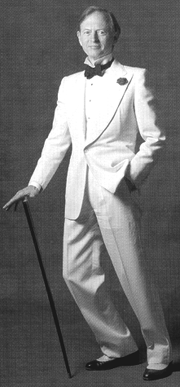
2001 Dean's Forum: Tom Wolfe
SAS
2001 Dean's Forum: Tom Wolfe
Each year the School of Arts and Sciences Dean's Forum presents leading figures in the arts and sciences that exemplify the liberal arts tradition. This year SAS presents author Tom Wolfe, who will discuss The Third Millenium and the Spirit of the Age, on Wednesday, April 18.
Known as the father of New Journalism, Mr. Wolfe's books include The Bonfire of the Vanities, In Our Time, From Bauhaus to Our House, The Right Stuff and A Man in Full.
Mr. Wolfe was born and raised in Richmond, Virginia and educated at Washington and Lee University and Yale University. He began his newspaper career in 1956 at the Springfield Union, and in 1960 was The Washington Post's Latin American correspondent. During his time there he won the Washington Newspaper Guild's foreign news prize for his coverage of Cuba. In 1962 he joind the New York Herald Tribune.
In 1965 his first book was published, The Kandy-Kolored Tangerine-Flake Streamline Baby, which became a bestseller and established Mr. Wolfe as a leading figure in the literary experiments in nonfiction that became known as the New Journalism.
The SAS Dean's Forum offers the University community and the general public the opportunity to meet with leading intellectual figures that exemplify the liberal arts tradition. The Dean's Forum also recognizes outstanding undergraduate and graduate students in the arts and sciences for their academic performance and intellectual promise.
The forum is free and will be held in the Harrison Auditorium at the University Museum, at 4:30 p.m. on April 18. For more information call (215) 898-5262.
Internet2's First Educational, International Videoconference Project
Business students at Penn and the University of Grenoble participated in a pioneering videoconference held via Internet2, the high-speed, high-bandwidth web of the future. The online session linked students here and in Grenoble in a cross-cultural discussion of the viability of a fast-food franchise in the French city.
Believed to be the first integration of Internet2-based international conferencing into university coursework, the April 6 session is a milestone for the heavy-duty successor to today's Internet. It also helps pave the way for future conferences to use Internet technology--not travel--to bring together speakers, panels and audiences around the world.
The videoconference was the culmination of a joint project undertaken this semester by business students in Wharton and their peers at the école Superieure des Affaires in Grenoble. Students at both institutions have been considering whether, in light of its successful expansion in Asia, the KFC Corporation should open a franchise in Grenoble. At the April 6 session--eagerly awaited by KFC--the 20 American and French students shared their recommendations--in French peppered with "spicy barbeque sauce"--including their views on the legal, financial and cultural issues raised by the case.
The conference was the fourth and final session linking Penn and Grenoble this semester. A faculty videoconference occurred February 26, and the students had their first online conference February 28 and another last month. The quality and speed of these transmissions has approximated that of a live television broadcast.
At Penn, the project has been a highly collaborative one, involving Wharton's Lauder Institute of Management and International Studies, the Department of Romance Languages in SAS, the distance learning program in CGS, the Office of Information Systems and Computing Networking & Telecommunications and the Law School's multimedia center.
Language professors have embraced the effort as a way to advance language education in business settings, while business professors say the interaction informs students of the importance of cultural sensitivities and differences in multinational transactions. Dr. Richard Herring, director of the Lauder Institute, said that Internet2 allows students the closest thing to immersion without setting foot outside the U.S. He hopes to expand this pilot project to introduce students to their peers in other nations.
"We're essentially giving these students high-tech pen pals," said James J. O'Donnell, vice provost for information systems and computing. "In the long term, we hope this technology will make distance disappear as a limiting factor for students."
Dr. O'Donnell said the possibilities for collaborative, multinational efforts involving Internet2 are limited only by the imagination of educators; Penn's division of Information Systems and Computing is actively seeking faculty members in all disciplines interested in using technology to reach out to all the world's resources. The time required to set up such sessions, now weeks or months, should decrease as the technology matures.
While most online applications use only a tiny fraction of Internet2's massive bandwidth, seamless international videoconferencing like that now taking place at Penn is one of the few that requires moving far greater quantities of data than today's Internet can handle. The current-generation Internet used in homes and offices everyday permits rudimentary videoconferencing, but both audio and visual quality are much choppier than than that which Internet2 allows.
Penn is a founding member of the Internet2 consortium of schools and universities working to develop and deploy advanced network applications and technologies, accelerating the creation of tomorrow's Internet. With a 155-megabyte connection to Internet2 supporting bandwidth-intense applications such as the National Digital Mammography Archive and the National Tele-Immersion Initiative, Penn was a participant in the world's first totally virtual conference event last October.
Penn is also home to the Metro Area GigaPoP in Philadelphia, one of several dozen gigapops, or regional portals to Internet2, scattered across the U.S. With Penn's backing, the Metro Area GigaPoP has linked other Philadelphia-area institutions to Internet2, including Lehigh University, and is seeking additional partners.
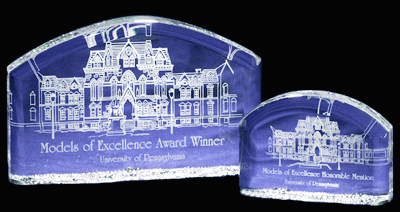 |
The 2001 Models of Excellence award winners and honorable mention recipients were honored at a ceremony last week where they received an etched glass award and a monetary award. See Almanac February 27 for a list of the honorees and their contributions to the University. |
Almanac, Vol. 47, No. 29, April 10, 2001