 National
Medal of Science: Dr. Hirschmann National
Medal of Science: Dr. Hirschmann
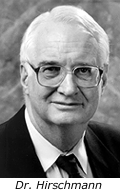
Penn chemist, Dr. Ralph F. Hirschmann, is a recipient of the 2000 National
Medal of Science, President Bill Clinton announced on November 13. Dr. Hirschmann
and the eleven other honorees will receive their medals at a White House
dinner on December 1.
Dr. Hirschmann, the Rao Makineni Professor of Bioorganic Chemistry, joined
Penn in 1987 after retiring as Merck's senior vice president of basic research.
He was affiliated with Merck for 37 years, during which time he contributed
to the development of several important drugs. While at Merck and since
coming to Penn, he has fostered interdisciplinary research as well as collaborations
between academia and industry
"These exceptional scientists and engineers have transformed our
world and enhanced our daily lives," President Clinton said. "Their
imagination and ingenuity will continue to inspire future generations of
American scientists to remain at the cutting edge of scientific discovery
and technological innovation."
"This is a truly great honor and we offer our warmest congratulations
to an extraordinary Penn researcher and member of the faculty," said
Penn President Judith Rodin. "Ralph Hirschmann is an outstanding scientist
whose pathbreaking work in the field of chemistry has led to the development
of many lifesaving medicines. His creativity and vision have led to a unique
collaborative research program between the University and the biomedical
industry that will continue to produce new bodies of knowledge for the benefit
of society for many years to come."
A half-dozen widely used medications stem from Dr. Hirschmann's tenure
as Merck's head of basic research, including the parasite-fighting Ivomec,
now used to combat river blindness in developing nations. The work of his
colleagues at Merck has also led to drugs to treat hypertension, congestive
heart failure, severe infection and hypercholesterolemia.
Dr. Hirschmann's seminal contributions to organic and medicinal chemistry
also include the first chemical synthesis in solution of an enzyme, ribonuclease,
in 1969, regarded as one of synthetic organic chemistry's noteworthy achievements
of the 20th Century. Early in his career, in 1952, he discovered that chemical
transformations can be controlled at the same time by both the disposition
of electrons and the geometric arrangement of atoms. This concept, which
Dr. Hirschmann termed stereoelectronic control, has gained great importance
in chemistry.
Dr. Hirschmann was elected a member of the American Academy of Arts and
Sciences in 1981 and elected to the National Academy of Sciences in 1999.
He has also received the Arthur C. Cope Medal--the American Chemical Society's
highest honor for organic chemists--and an issue of the Journal of Medicinal
Chemistry was dedicated to him in 1992.
A native of Germany, Dr. Hirschmann received his baccalaureate from Oberlin
College and his doctorate from the University of Wisconsin. After three
years of Army service in the Pacific Theater during World War II, he joined
Merck as a process research chemist in 1950, where he rose to senior vice
president of basic research by 1978. During his time in that post, Merck
developed Mevacor, Vasotec, Prinivil, Primaxin, and Proscar.
In addition to his Penn post, Dr. Hirschmann served from 1987 to 1999
as University Professor of Biomedical Research at the Medical University
of South Carolina. That university and Wisconsin have both established Ralph
F. Hirschmann professorships in his honor. He holds honorary doctorates
from these two institutions as well as Oberlin, where he also served on
the Board of Trustees.
Dr. Hirschmann has authored some 150 scientific papers, primarily on
steroid and peptide/protein research, and is named inventor or co-inventor
on nearly 100 patents. He was chairman of the Board of Trustees of the Gordon
Research Conference in 1984-85 and currently serves on the editorial or
advisory boards of numerous international journals. He also served on a
study section of the NIH and on committees of the National Research Council
and the NSF. |