 Flower
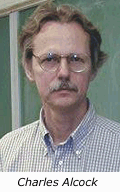
Professor of Astronomy and Astrophysics: Dr. Alcock Flower
Professor of Astronomy and Astrophysics: Dr. Alcock
Dr. Charles R. Alcock has been named the Reese W. Flower Professor of
Astronomy and Astrophysics. Dr. Alcock, a theoretical physicist, comes to
Penn from the Lawrence Livermore National Laboratory where he was Director
of the Institute of Geophysics and Planetary Physics and the Principal Investigator
of the MACHO Project, an international dark matter experiment. He was educated
at the University of Auckland (in his native New Zealand) and at the California
Institute of Technology, where he graduated with a Ph.D. in 1978. In 1996,
he was the recipient of the E.O. Lawrence Award in physics for "scientific
and technological leadership" in the hunt for "dark matter,"
a leading mystery in the field of astronomy.
For two decades, astronomers have believed that our galaxy has a lot
more mass than is visible. That missing mass is called dark matter. A team
of astronomers, led by Dr. Alcock, believes that periodic extra light from
distant stars provide evidence that could help account for about half the
missing parts of the Milky Way. Significantly, they have found evidence
of about 20 compact but massive objects--nicknamed MACHOs for Massive Compact
Halo Objects. Finding these MACHOs in a relatively thin slice of the galaxy,
"it figures these invisible objects can account for about half of the
galaxy, or about 325 billion times the weight of our sun," Dr. Alcock
said.
The Reese W. Flower Chair in Astronomy and Astrophysics was established
through a bequest from Reese Wall Flower in the late 19th century. His bequest
also funded the Flower Observatory (now the Flower and Cook Observatory)
which was originally located on his farm in Upper Darby, PA. While Mr. Flower
did not attend Penn, the fact that he was a descendent of George Graham
of London, a famous maker of astronomical instruments, may explain his interest
in astronomy. The first Flower Chair was awarded in 1982 to Dr. Ezra Kendall,
who according to one contemporaneous account was credited with "all
of the data relating to Jupiter and its satellites..were computed by him." |
 Carey
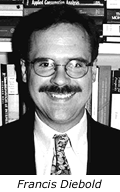
Term Chair in Economics: Dr. Diebold Carey
Term Chair in Economics: Dr. Diebold
Dr. Francis X. Diebold has been named the W. P. Carey Term Professor
in Economics. Dr. Diebold works in econometrics, forecasting, finance and
macroeconomics. He has published extensively and has served on the editorial
boards of numerous journals, including Econometrica and Review
of Economics and Statistics.
He is a Fellow of the Econometric Society and the recipient of several
prizes for outstanding teaching in economics, finance and statistics. Dr.
Diebold has held visiting appointments at Princeton University, the Graduate
School of Business at the University of Chicago, and the Stern School of
Business at New York University. From 1986-1989 he served as an economist
under Paul Volker and Alan Greenspan at the Board of Governors of the Federal
Reserve System in Washington D.C. Dr. Diebold received his B.S. in 1981
and his Ph.D. in 1986 from the Wharton School.
The W. P. Carey Term Chair in Economics is the third economics term chair
created by William Polk Carey, a 1953 alumnus of the Wharton School. Mr.
Carey, who studied economics while at Penn, remains committed to its study
at Penn. He established the William Polk Carey Prize in Economics and has
been a major supporter of the Institute for Economic Research. In addition
to his generous financial support, Mr. Carey provides valuable leadership
in the Penn community and is extremely active in the Department of Economics. |
 Merriam
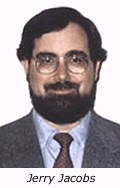
Term Chair in Sociology: Dr. Jacobs Merriam
Term Chair in Sociology: Dr. Jacobs
A new chair in sociology has been established and its first incumbent
is Dr. Jerry Jacobs. Dr. Jacobs has been named the Merriam Term Chair in
Sociology. He received his Ph.D. in sociology from Harvard in 1983 and joined
the Penn faculty that year. He served as chair of the sociology department's
graduate program for seven years and is a member of many departmental and
University committees.
He has received numerous awards and fellowships, such as the American
Sociological Association Max Weber Award for Best Paper, a Russell Sage
Foundation Residential Fellowship, and a National Academy of Education-Spenser
Foundation Fellowship.
Dr. Jacobs has published several books and dozens of articles, book reviews
and essays. He has been on the editorial boards of American Sociological
Review, Social Forces, and Work and Occupations. Dr. Jacobs is
also a member of many professional societies, including the American Sociological
Society, the International Sociological Association, and the Population
Association of America.
The Merriam Term Chair in Sociology was created from the late John W.
Merriam's generous bequest to Penn. Born in Chicago in 1907, Mr. Merriam
received his bachelor's and master's degrees from Penn's Wharton School,
and taught economics here in 1934. |
 Lawrence
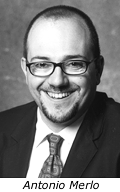
R. Klein Associate Professor of Economics: Dr. Merlo Lawrence
R. Klein Associate Professor of Economics: Dr. Merlo
Dr. Antonio M. Merlo has been named the Lawrence R. Klein Associate Professor
of Economics. Dr. Merlo received his undergraduate degree in economics from
Bocconi University in Italy and received his Ph.D. from New York University.
In 1988, he began his career as a research associate at Italy's National
Research Council before deciding to pursue graduate training in the United
States. He later worked for the Federal Reserve Bank in Minneapolis before
returning to academia, first at the University of Minnesota and later at
NYU before coming to Penn this year. His research interests include political
economy, public economics, applied econometrics, bargaining theory and experimental
economics.
He has published numerous articles and recently received a National Science
Foundation Research Grant for a study of "A Political Economy Model
of Congressional Careers" co-authored with Michael Keane.
The Lawrence R. Klein chair was created in honor of Professor Lawrence
R. Klein, Benjamin Franklin Professor Emeritus of Economics and Nobel Laureate
in Economic Sciences. It is intended for scholars who will carry on the
tradition of superlative teaching and research established by Professor
Klein. |
 Watkins
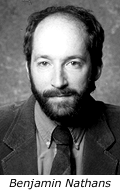
Assistant Professor in Humanities: Dr. Nathans Watkins
Assistant Professor in Humanities: Dr. Nathans
Dr. Benjamin Nathans has been appointed the M. Mark & Esther K. Watkins
Assistant Professor in the Humanities. Dr. Nathans, an assistant professor
of history at Penn, completed his undergraduate education at Yale and received
his M.A. and Ph.D. in history from the University of California, Berkeley.
He came to Penn in 1998 from Indiana University where he had been an assistant
professor of history and Jewish studies since 1995.
Dr. Nathans' book, Beyond the Pale: The Jewish Encounter With Late
Imperial Russia was recently published as a volume in the series "Studies
on the History of Society and Culture." He has also authored dozens
of articles, book chapters, and book reviews and delivered his papers throughout
the United States.
He has won over twenty distinguished fellowships; including a Penn Research
Foundation Faculty Fellowship, SSRC Postdoctoral Fellowship, and a Lucius
N. Littauer Foundation Book Project Grant. Dr. Nathans also serves a manuscript
reviewer for Slavic Review, Jewish Social Studies, and the Koret
Foundation.
Mr. Mark Watkins, a graduate of the Class of 1921, and his wife Esther
established a bequest in 1969 to support a chair in the humanities, even
though Mr. Watkins majored in chemical engineering. As an undergraduate,
Mr. Watkins was a member of Alpha Chi Sigma and Alembec Senior Society.
In his professional life, Mr. Watkins was the president of Conoflaw Corporation
and served as a director of several other corporations. The Watkins chair
was intended for a scholar who is "an accomplished teacher and one
who shows potential as a leader" in his or her field. Beyond that,
he or she should show a breadth of knowledge and accomplishment spanning
more than one discipline and, most importantly, have "a lively awareness
of the role and ramifications of the humanities, as they touch upon cultural
values and aesthetics and human history." |
|
 Annenberg
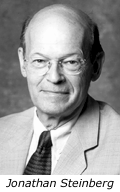
Professor of Modern European History: Dr. Steinberg Annenberg
Professor of Modern European History: Dr. Steinberg
Dr. Jonathan Steinberg has been appointed the Walter H. Annenberg Professor
of Modern European History. Dr. Steinberg received an A.B. at Harvard College
and a Ph.D. from Cambridge University in England. Dr. Steinberg has come
to Penn this fall after more than 30 years at Cambridge University. He has
written on twentieth century Germany, Italy, Austria and Switzerland and
has also prepared the official report on the Deutsche Bank's gold transactions
in the Second World War. His teaching covers modern Europe since 1789 with
specialization in the German and Austrian Empires, Nazi Germany, Fascist
Italy and modern Jewish history. He has also taught graduate seminars in
historical thought and method. He has published numerous articles and translations
and is the co-editor of Historical Journal. His most recent books
are All or Nothing: the Axis and the Holocaust 1941-43 published
in London and New York by Routledge and Die Deutsche Bank und thre Goldtransaktionen
im Zweiten Weltkreig (also published in English) by Verlag. Dr. Steinberg
has been a frequent presenter on BBC radio documentaries.
The Walter H. Annenberg Chairs were created by Walter and Leonore Annenberg.
The Annenbergs are lifelong supporters of Penn and patrons of education
across the United States. They have endowed many chairs in the School of
Arts and Sciences and made countless generous contributions to the University.
They also founded the Annenberg School for Communication in 1958. Ambassador
Annenberg and his wife, the Honorable Leonore Annenberg, are emeritus trustees. |
Kogod Term Chair in Psychology: Dr. Fara
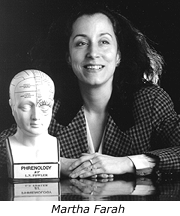
Dr. Martha Farah has been named the Bob and Arlene Kogod Term Chair in
Psychology. Dr. Farah received her Ph.D. in experimental psychology from
Harvard in 1983; she completed her undergraduate education at Massachusetts
Institute of Technology in 1977. Prior to joining the Penn faculty in 1991,
she served as a professor of psychology at Carnegie Mellon University.
Her current research centers on the neural bases of thought and emotion
in the human brain. Dr. Farah's current interests include the effects of
poverty on brain development in children. She has published her research
extensively and received many awards. Her honors include a Guggenheim Fellowship
in 1996, a Troland Research Award from National Academy of Sciences in 1992,
and a Distinguished Scientific Award for an Early Career Contribution from
the American Psychological Association in 1992.
The Bob and Arlene Kogod Term Chair in Psychology was created in 1992.
Mr. and Mrs. Kogod are very active in philanthropic circles, particularly
in the Washington DC area. Arlene Kogod, who has a keen interest in psychology,
graduated from Penn in 1956 with an economics major from the College for
Women, which later merged with the College to create the School of Arts
and Sciences. |
 Edmund
and Louise Kahn Term Chair: Dr. Meister Edmund
and Louise Kahn Term Chair: Dr. Meister
Dr. Michael W. Meister, professor of history of art and professor of
South Asia Studies, has been appointed the Edmund J. and Louise W. Kahn
Term Professor. He received his B.A. in history and literature from Harvard
University, as well as an M.A. and Ph.D. in fine arts. He taught at University
of Texas at Austin for two years before coming to Penn in 1976.
An expert in the art of South Asia, some of Dr. Meister's most recent
publications include the two volume Encyclopedia of Indian Temple Architecture,
published by Princeton University Press and Oxford University Press
and Ananda K. Coomaraswamy: Essays in Architectural Theory, published
by Indira Gandhi National Centre for the Arts and Oxford University Press.
Dr. Meister lectures widely in the United States, Europe and in India.
He is a member of several professional associations including Association
for Asian Studies, American Committee for South Asian Art, and the College
Art Association. Last year he curated an exhibition of drawings from Jain
Temples at Osian and Rajasthan titled "Jains as Temple Worshipers:
Architecture and Planning," on display in Penn's Architectural Archives.
The Kahns were remarkable philanthropists who gave generously to Penn,
most significantly to Van Pelt Library, the Modern Languages College House,
and support faculty in the School of Arts and Sciences. |
 Korea
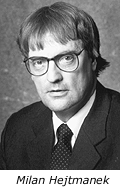
Foundation Assistant Professor in History: Dr. Hejtmanek Korea
Foundation Assistant Professor in History: Dr. Hejtmanek
Dr. Milan Hejtmanek has been named the Korea Foundation Assistant Professor
in History. Dr. Hejtmanek received his B.A. in linguistics from Stanford
in 1974, his M.A. in East Asia regional studies from Harvard in 1982, and
his Ph.D. in history and East Asian languages from Harvard in 1994. He is
joining Penn from Harvard, where he has been an assistant professor of Korean
history since 1995. He also has served as visiting assistant professor at
Berkeley and acting assistant professor at the University of Kansas. His
research interests focus on Chosôn Korea and encompass the social,
political, and cultural importance of local educational institutions; the
institution of slavery; Confucian thought; and magic and ritual in the royal
court.
Dr. Hejtmanek has received many honors including a Presidential Fellowship
from Harvard, a Korea Foundation Research Fellowship, and a Fullbright Dissertation
Fellowship. He has published several works and has presented his papers
throughout the world.
This chair was created in 1997 when the Korea Foundation awarded Penn
a challenge grant to establish teaching positions dedicated to encouraging
an understanding of Korea. The Korea Foundation was founded in 1991 to enhance
international goodwill and friendship through a variety of international
programs. Its mission is to foster a better understanding of Korea in the
international community and to promote international friendship through
exchange activities between the Republic of Korea and other countries. |
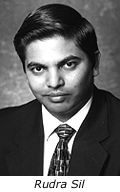 Bers Assistant
Professor in the Social Sciences: Dr. Sil Bers Assistant
Professor in the Social Sciences: Dr. Sil
Dr. Rudra Sil has been appointed the Bers Assistant Professor in the
Social Sciences. Dr. Sil received his undergraduate and graduate degrees
in political science from the University of California, Berkeley. After
completing his Ph.D. in 1996, he joined Penn as an assistant professor of
political science.
His teaching and research interests include comparative politics and
political economy, comparative industrial relations, Russia, South Asia,
and the philosophy of social science. He is the author of several articles
and book chapters, and his first book, Managing 'Modernity': Work, Community,
and Authority in Late-Industrializing Japan and Russia, is forthcoming
from the University of Michigan Press. Dr. Sil has received numerous grants
and fellowships, including a University of Pennsylvania Research Foundation
Grant, a Christopher H. Browne Center for International Politics Faculty
Research Grant, and a John L. Simpson Memorial Fellowship for Research in
Comparative Studies.
Penn alumni Janice and Julian Bers established the Bers Assistant Professorship
in the Social Sciences in 1972. The chair is intended to recognize an assistant
professor who demonstrates outstanding promise as a teacher and scholar
in the social sciences. Julian Bers, who passed away several years ago,
graduated from Wharton in 1931 and had been chairman of Imperial Metal and
Chemical Company. He served on many Penn volunteer boards, most notably
as a Trustee of the University and board member at HUP. Janice Bers graduated
with an education degree in 1939. She served as president of her class for
many years and participated in the class's 50th reunion gift committee.
The Bers have given generously to Penn over the years, and faculty excellence
has been their chief priority. |
|
