
COUNCIL State of the University,
Part Two
At the University Council meeting on October 4, the President and Provost presented their annual State of the University reports. Below is the report given by Provost Robert Barchi.
President Judith Rodin's report was published in the October 10 issue of Almanac. --Ed.
ADMISSIONS | RESEARCH | ACADEMIC INITIATIVES | ACADEMIC FACILITIES | CAMPUS LIFE | FUTURE | Q&A | TOP
The State of the University, 2000-2001 by Robert Barchi
I would like to pick up where President Rodin left off. The President gave you a broad overview of the State of the University during the past year. I'd like to look down a little deeper in a few selected areas. There is so much going on that in the limited amount of time I have available we can't possibly touch on each and every project. If there are areas that you want to explore further we can do that in the questions afterwards.
Admissions
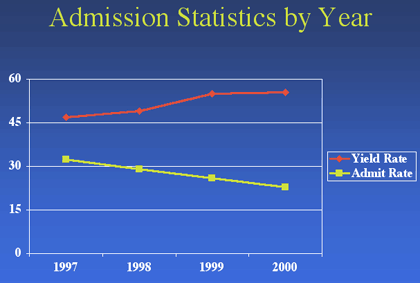
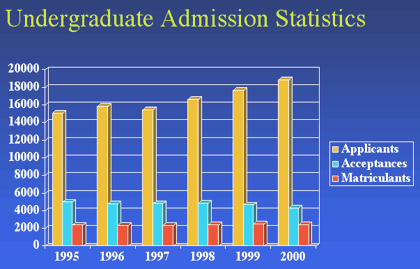
Let me return first to the issue of our undergraduate admissions. Very briefly, what you saw in the President's table is that over the course of the last few years the number of applications to Penn has taken off dramatically. With a constant class size of about 2,400 students, the number of students that we actually accept in order to matriculate this class size has declined and the ratio of this to the total has clearly gone up. This leads to a progressive improvement in our indicators. There are two statistics that we look at most; they are the yield rate and the admit rate. This indicates that the University of Pennsylvania is becoming progressively more selective, reaching into the very top ranks of American universities in terms of selectivity. At the same time students prefer us to other choices in the market place. When we offer the opportunity to matriculate at Penn; more and more of the students offered that opportunity taking it.
At the same time the quality of our students continues to rise. Average SAT scores are only one of the many measures that we use. The students that applied to Penn in FY 2000 had an average SAT score of about 1350. The ones who we accepted had scores of over 1400 and our matriculating class averaged 1392, making this along with all the other parameters that we look at clearly the most selective class that we have admitted to Penn. Our classes each like to brag about the fact that they have become the most selective class to get to Penn. And those of you graduating this year can be proud that you are part of the most selective class to graduate from Penn. For at least a year.
Let me mention one other fact--the number of early decision applications to Penn. You can see that there is a progressive rise in early decision applicants. We received 2,570 applications for early decision to Penn and I think this reflects a trend for other very highly selective schools in the nation. The acceptance rate for the early applicant pool is about 39%. These are very highly qualified individuals who are already precommitted to Penn, and their matriculation rate will be well up in the high 90s. The acceptance rate for standard applications reviewed in the spring is about 19%. We expect that this trend will continue in the future and that individuals will be more inclined to identify with and commit to Penn in the early acceptance pool.
ADMISSIONS | RESEARCH | ACADEMIC INITIATIVES | ACADEMIC FACILITIES | CAMPUS LIFE | FUTURE | Q&A | TOP

ADMISSIONS | RESEARCH | ACADEMIC INITIATIVES | ACADEMIC FACILITIES | CAMPUS LIFE | FUTURE | Q&A | TOP
Research
Let me move on now to a brief discussion of research. As the president indicated, research is essential for the generation of new knowledge for intellectual activity on campus. It is hard to quantitate that, but one way is simply keep in mind the percentage of our academic budget that is comprised of income from research activity, both direct support and indirect cost recovery. About 33% of cash flows through the academic budget of the University. And the slide below (Total Awards Received) puts in perspective the trends that we have seen here for total research awards over the past ten years. I want to call your attention to the last five or six years, when the rate of growth of research activity at Penn has really been quite phenomenal. Last year it reached a total of $546 million--over a half billion dollars worth of sponsored research at Penn. That certainly is partially due to the fact that the School of Medicine has for every year in the past decade been number one in the nation in the rate of growth in the NIH sponsored research. The rest of the University is also growing at a very respectable rate.
So we look at our academics, our teaching and our research as being a hallmark of our academics. We are literally winning a larger share of the national pie in the research market and this reflects extremely well on the University. At the same time, as the president indicated, it also causes strains on our resources because of the challenges that we face in research.
First, there is the actual cost of research itself. While we continue to bring research dollars into the University, it costs us dollars to perform that research, both in the maintenance of buildings and the support of the personnel. On the other hand, the amount of indirect cost recovery provided to us from the government is declining and one of our very biggest challenges is to figure out how to cover the cost of research even as our research base grows.
During the past year we have asked Arthur Anderson, an academic consulting firm, to look at this problem and they are reporting out to us now. I also have a task force working for the provost's office to look carefully at the cost of research and see how we can get that issue under control.
The second critical issue is the research infrastructure. The manpower required to handle this huge volume of grants is considerable and we have to work very hard to use technology to provide the kind of services that our scientists and humanities investigators expect.
Finally, of course regulations governing research of all kinds, are expanding exponentially, and the burden of regulatory work required on the part of the investigator and the University is increasing dramatically.
As you know, we have had some major issues in human research. At the president's request, I have put together a committee on research using humans that has been working since last spring and has already issued an interim report. The committee has completed a review of our entire IRB system and many recommended changes have already been put in place. It has carried out a users' survey of the researchers who function in this area. We have contracted with an external monitoring agency to review our current clinical trials and help us with the monitoring of high-risk trials in the future, developing standard operating procedures for research and for IRB panels. We have just sent to the Senate modifications that we recommend in our conflict of interest policy related to human research. We believe that we will be at the cutting edge in terms of research universities doing human research. Far from being in the position of shutting down our human research enterprise, I want to make it very clear that we will continue to be one of the premier institutions in the world in terms of the quality of research we do using humans.
ADMISSIONS | RESEARCH | ACADEMIC INITIATIVES | ACADEMIC FACILITIES | CAMPUS LIFE | FUTURE | Q&A | TOP
Academic Initiatives
Let me move on to a brief overview of academic initiatives that we have put in place during the past year. I will start with some Agenda for Excellence programs and highlight just three.
The first is the Institute for Urban Innovations, which will be a premier location for thinking and research about cities and their future, and a unique campus hub linking faculty, undergraduates, doctoral and professional students, post-docs, and senior research scientists in a community of learning focused on research on urban issues. This will be housed in the Fels Center.
The second is the Center for Children's Policy Practice and Research. This particular center, which we just celebrated the official opening of a few weeks ago, is a collaboration between the Law School, the School of Social Work and the School of Medicine. It seeks innovative solutions to the legal, societal health-crisis facing America's children. The Center will concentrate on interdisciplinary policy on research, practice, and study among faculty and students in a number of schools and departments, centers and institutes throughout the University. It will bring together unusually talented and experienced experts from across our campus, and additional staff from around the country. This is really an innovative program that I think will set up a benchmark for how things are done in this particular field.
Finally, you will see in a few weeks an announcement about a genomics initiative on campus representing a coalition of efforts from various schools including Medicine, SAS, and SEAS in a number of programs. One of these will emanate from the provost's office, another from the Cancer Center, and others from other areas in the University. This will be the next revolution in the life sciences. If you think back to the 1970s, to the advent of the enzyme technology that allowed us to manipulate RNA and DNA, and the introduction of molecular biology to the life sciences and what a transition that made, I would say that transition is minor compared to the tidal wave that you will see with genomics.
With the completion of the human genome project and the availability of complete sequences for an increasing number of other organisms, the approach in the biological sciences will shift from a focus on individual molecules to a focus on whole genome expressions, whole protean constitution of cells and organisms and will require huge capabilities in data analysis. The interface between bioinformatics, information sciences, computer technology, SEAS, the biological sciences, SAS and life sciences and medicine represent enormous opportunities for Penn. We will be at the cutting edge of that field.
Moving on to other areas, you probably are aware of the new student orientation that was put in place this year. I commend our deputy provost Peter Conn, and his staff, and Val Cade and her staff for the tremendous work they did, to extend the new student orientations from 4 to 7 days, giving us a greater academic and cultural focus for our incoming students, widening our advising opportunities for those students, and expanding exposure to the city and the community. As an example, we hosted five different tours for our freshmen in various areas of Center City and West Philadelphia. They were staffed and led by a huge cadre of our graduate students trained in these areas; it was a remarkable exercise, which has proven to be very popular.

ADMISSIONS | RESEARCH | ACADEMIC INITIATIVES | ACADEMIC FACILITIES | CAMPUS LIFE | FUTURE | Q&A | TOP

ADMISSIONS | RESEARCH | ACADEMIC INITIATIVES | ACADEMIC FACILITIES | CAMPUS LIFE | FUTURE | Q&A | TOP
Academic Facilities
The President mentioned the campus development plan. We are very pleased with the progress that's been made; most of you have heard presentations there, and I've heard some of the recommendations on that plan. Let me highlight for you three academic projects that are coming up on the facility side, just to point out how we can work together between academic program and the campus development plan.
The President indicated that the Graduate School of Education was an adaptive reuse of an existing building, one of the main foci of the campus development plan begun in September. It will take us about 18 months to complete the project, and will refocus the life of this building to a very dynamic and exciting project along Walnut Street. It will bring a lot of life to that side of the street. At the same time, it will increase the effective usable area in the building so that many more Graduate School's academic programs can be housed in this pre-existing but newly renovated building.
A second example, at the recommendations of the committee, is to focus on academics in the core of campus to remove surface parking lots from the core and to utilize that space. An example here is engineering, with the removal of surface lots and taking advantage of a prime little piece of real estate, that allows us to expand the program in computer and information sciences, build this within a building, and house our new faculty in that area. It is our hope that we can do the same thing on the other side of the engineering complex. In the second area in which we think there are tremendous opportunities for engineering, namely in bioengineering. This is an area where we can link the engineering complex here with the school of medicine, a proximity that's rare for engineering schools in the country. There are very few places in the country that have an undergraduate and graduate engineering school, literally across the street from a world-class medical school and healthcare delivery system.

Finally, another recommendation of the task force was to think of ways to redefine and strengthen ties between our schools and our disciplines. This has really been the thought behind the life sciences building. This will allow us to bring psychology and biology together in an area around the biology pond that can link the School of Veterinary Medicine and the research facilities of the School of Medicine into an integrated life sciences research campus.
We believe that this building, which will also house our genomics capabilities, will be a model for how we can integrate academic disciplines across schools and across disciplines, rather than having them all vertically distributed within individual departments. The programming is complete, the design phase is under way now, and we hope that we will move into the construction phase within the next year.
And finally as the President indicated, one of our main priorities for the coming year is to focus on the humanities. You may recall our presentations last year and remember that when talking about SAS we identified three areas: the life sciences was one, we have gotten to that this year; the humanities was another one. Our prime focus, certainly one of my primary interests for this year, is to come up with a revival plan for dealing with English and Music and History and the facilities that they need to support the outstanding work that they do for the University.

ADMISSIONS | RESEARCH | ACADEMIC INITIATIVES | ACADEMIC FACILITIES | CAMPUS LIFE | FUTURE | Q&A | TOP
Campus Life
Let me just touch briefly on campus life. Many of you heard this topic before, one that I come to many times, and that is the idea that we are a community of scholars. What I really hope we are here, in essence, is a community, an in-depth community of students and staff and faculty that really underscores what this University is about. I have taken a number of initiatives to try to knit that community together; the Provost's Lecture Series kicked off this year with Jeremy Siegel to a sold-out crowd. We will also have this year Risa Lavizzo-Mourey and Larry Gross winding up the semester in the lecture series. The provost's spotlight series is another initiative that is underway. The first spotlight event was an evening of arts and culture during New Student Orientation week which was quite successful. We will also cosponsor an event during Academic Integrity Week; and we are co-sponsoring, along with the library, the 100th anniversary of the publication of Sister Carrie. We also sponsor interdisciplinary seminars for groups that are willing to bring together various disciplines and we provide resources for those. And working with Peter Conn we have the provost's council on arts and culture, again trying to bring together the community and take advantage of the various resources and treasures we have here on campus.
Another example of what we can do when University campus life was the program on Locust Walk where we had a unique opportunity with the availability of 3619 and the Veranda and the Christian Association to look at a whole region of our core campus in a manner that's consistent with the campus development plan. We took the opportunity to rethink how to revitalize that area to make it into a diverse mix of academic, cultural and residential activities. We were looking for ways to make this area active night and day and I think that we have come up with a very interesting and viable plan. We have a number of academic programs including the McNeil Center--the Humanities Forum, and Folklore in one part of our Locust Walk; our graduate students and their programs in an adjacent building; and we are holding a space open for a residential community of Greeks, potentially a sorority next to that. In a move that epitomizes our direction here in the old Christian Association we created the ARCH. The program includes the arts, research and culture in a single facility and is really designed to provide separate space for recognizing the uniqueness of each of these programs but also an environment that encourages interaction among them. That allows them to take advantage of what is so valuable about a university community.
ADMISSIONS | RESEARCH | ACADEMIC INITIATIVES | ACADEMIC FACILITIES | CAMPUS LIFE | FUTURE | Q&A | TOP
Future
Let me take just the last few minutes to let you know where we are going. During the next year, we have a busy year planned. Some of the programs that will emanate from the provost's office, between the faculty and the administration include the review of our copyright policy and the revision of copyright. This is now back in the hands of the Faculty Senate and hopefully we can move that to a conclusion this fall so that issues related to intellectual property can be solidified and we can really make some aggressive moves in technology transfer. You have heard about the Gender Equity Task Force; it will be followed by a task force dealing with minority recruitment and retention. Hopefully that committee will report out in the fall of 2001. We have just named members to a Faculty Retirement Task Force, jointly with the Senate for a reporting date in the spring of 2001. There is a research misconduct policy group working, which will also report out in the spring of 2001. So we have a very busy academic year planned.
Let me highlight some of the key University-wide issues that we will be dealing with. One is this whole issue of Intellectual Property and tech transfer. Part of that is P2B, the broad issue of how we bring our intellectual property to the broader community.
The second, that I consider to be critically important will be how we position ourselves in the global environment. How do we want to be seen globally? What kind of positions do we want to take? What kind of relationships do we want to structure? We are actively pursuing a number of options there and we need a University-wide policy.
Graduate education is another priority. The critical nature of graduate education to the intellectual enterprise of our faculty is an area that has been under- emphasized here at Penn. Although we have outstanding graduate programs, I don't believe that they get the visibility that they should, certainly not with the trustees.
Faculty recruitment and retention always deserves the very highest level of attention because after all the faculty are our most precious resource. We can build all these buildings but if we lose our faculty there will be no one here to man them.
This year it is the time to once again revisit the Strategic Plan as part of a six-year cycle. We will begin the process of thinking about where we are going as a university starting with a Trustee Retreat in another month. Then we will move to a very broadly based process involving the rest of the faculty, staff and students during the course of the remainder of the year.
That concludes my report.
ADMISSIONS | RESEARCH | ACADEMIC INITIATIVES | ACADEMIC FACILITIES | CAMPUS LIFE | FUTURE | Q&A | TOP
Q&A
Mr. Sherr: Just a really small question. When you are talking about the Graduate School of Education building are you reopening the entrance towards Walnut Street or will it continue to turn towards the center plaza between Stiteler?
Dr. Barchi: As part of a general effort to make Walnut Street a much more dynamic and attractive part of the campus, not just a thoroughfare, you will notice a number of those buildings are turning themselves around so they are not putting their back towards Walnut Street. They have entrances on both sides. Part of the renovations with GSE will include a major entrance on Walnut Street--on the left hand side is a very attractive glass lobby.
ADMISSIONS | RESEARCH | ACADEMIC INITIATIVES | ACADEMIC FACILITIES | CAMPUS LIFE | FUTURE | Q&A | TOP
State of the University, On-lineAvailable on Almanac's web site (www.upenn.edu/almanac/)are both the President's and the Provost's State of the University Addresses-complete with statistical charts, tables and graphs, which Almanac was not able to reproduce here in print. To see President Rodin's address along with statistical supplements, visit www.upenn.edu/almanac/v47/n07/StateOfUniv2K.html. To see Provost Barchi's address along with statistical supplements, visit www.upenn.edu/almanac/v47/n08/StateOfUniv2K.html. |
Almanac, Vol. 47, No. 8, October 17, 2000