
DEATHS
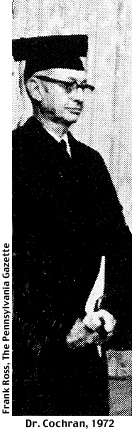 Dr. Cochran: Historian Who Changed
His Field
Dr. Cochran: Historian Who Changed
His Field
Dr. Thomas Cochran, a Benjamin Franklin Professor at Penn whose profound and prolific work as an economic historian was to change the way scholars approach American history, died on April 29 at his home in The Quadrangle, Haverford. It was his 97th birthday.
Thomas Childs Cochran was born in 1902 in New York City, where he set out to become a chemical engineer; but he turned to history before completing his B.S. in 1923 at New York University. After earning an M.A. there in 1925, he became an instructor in 1927 and continued on the NYU faculty while earning his Ph.D. from Penn in 1930. He rose through the NYU ranks to assistant professor in 1936, associate professor in 1943, and full professor in 1944.
He joined Penn in 1950 as Professor of the History of the American People, and except for a year as the Pitt Professor of American Institutions at Cambridge in 1965-66, he spent the rest of his distinguished career here.
Dr. Cochran was known for his work establishing that the American culture--its politics, its religion, its institutions--respond fundamentally to its economic being. He was also his generation's leading proponent of the application of social science techniques to the study of history. In the history department here, Professor Michael Zuckerman recalls the "staggering intellectual influence" of Dr. Cochran's teaching and his writing, both of histories and the major statements for the Social Science Research Council (notably Bulletins 54 and 64) that established new methods. His was also the first convincing argument to free American history from its organization by presidencies (American Historical Review, "The Presidential Synthesis"). Notably succeeding by example as well as by precept, in such books as the 1953 Railroad Leaders: The Business Mind in Action, he produced "not just the sweeping programmatic statement but the tight, analytic statement that he called upon us to do," said Dr. Zuckerman. "He studied a huge cache of correspondence by leading railroad executives to get at their world view and their frame of mind-so it's not just about railroads, not just about the business of railroads, but a stunning piece of intellectual history."
Dr. Cochran was author and co-author of some twenty books. His widely read basics include The American Business System (1957), A Basic History of American Business (1959) and Business in American Life (1972). While serving on a committee to plan the Philadelphia Bicentennial, he also prepared the 1977 book 200 Years of American Business. The Puerto Rican Businessman (1959) and Entrepreneurship in Argentine Culture (1962, with Ruben Reina) took him into comparative history, where he had a strong preference for combining the archival with field work, Dr. Zuckerman recalls. And in retirement he produced such works as Frontiers of Change (1981) and the 1985 Challenges to American Values.
The field recognized him nationally by electing him to head all three of its major societies--the American Historical Association, the organization of American Historians, and the Economic History Association. He was also a member of the American Philosophical Society, and among his many honors was an honorary degree from Penn, in 1972, where his citation read in part:
As the inventive constructor of his own estimable history, Thomas Childs Cochran has opened new vistas for the examination of the American heritage and its underlying social themes.
Bold and experimental, he was the first to emphasize the significance of private enterprise as the basis for this country's formative institutions at a time when such discernment was original, courageous, and striking. Considered by many to the be foremost American economic historian, he has influenced a new generation of scholars long after he suggested a change in problems and themes and introduced techniques from the social sciences into historical methodology. With the intensity of the seer, he has taught others to share with him the broad and long-range perspective that gives meaning to facts.
At the urging of colleagues, Dr. Cochran continued on the active faculty past the once-mandatory retirement age, staying "not only on top of the literature but ahead of it," said Dr. Zuckerman.
Widowed in 1976 on the death of his first wife, Rosamond Beebe Cochran, Dr. Cochran is survived by his second wife, of 10 years, Ann Widmer Cochran.
Memorial for Ed Lane
A gathering will be held on Friday, May 14, 4 p.m. in the Faculty Club Tea Room in memory of Edward Franklin Lane, who died in March at the age of 77. It is open to the University community. An obituary was promised, but there is some doubt about his wishes on the subject. In lieu of an obituary, then, here a news story from Almanac July 12, 1983-to which he raised no objection at the time.--Ed.
... And Then There's Lane's Way
Never mind the annual report. An even more agonizing year-end activity
in academia must be the planning of send-offs for those dozens who retire
after long and devoted service. Friends and co-workers struggle to crowd
into a single occasion enough tributes, tokens and tales-told-out-of-school
to offset the awful truth that there's about to be a gap in the life of
the institution. Friends of Development's Ed Lane went through the agony
this year, and it took half a dozen farewell celebrations to send him off
to his new career as full-time farmer. For "the" bash, in Gimbel
Gym, an all-University committee set out to do it his way--for Edward
Franklin Lane was the Master, the Czar, the Guru Extraordinarius, the Lone
Arranger of Penn events who probably put out more flags and struck up more
bands for others than anybody else during his 33 years' service in multiple
jobs. Thus a gymful of people in funny hats (Ed Who?) watched the
U.S. Marine Corps Color Guard (honoring some World War II assaults on Guadalcanal
and other scenic Pacific spots), Penn Band (which Mr. Lane helped bring
up from the doldrums to "the only undefeated band in the Ivy"),
and the Glee Club (which he once took on statewide bus tour to sing for
Penn's supper). It was a lesson in how-to-do-it, all right: String a banner
across the gym that morning; change the name of a street the way Ed Lane
always did it for United Way; get Bruce Montgomery to write a special medley.
Fill a milk bottle with money (for the old tractor's new tires?); pick out
a live steer and have Craig Sweeten (whom not even a Black Angus dares disobey)
wrangle it into the gym on the hoof; put 37 stars on Athletics' gift blanket
(adding four undergraduate years to his 33 as a staffer who "never
asked for a job and never turned one down"); call in Wharton Reprographics
to videotape for posterity. And above all, keep it light (Emcee Jim Shada.
Speakers Mark Allam, Sara Senior, Sheldon Hackney) so nobody quite bursts
into tears at the finale when the guests' lives as well as the honoree's
are rerun down memory Lane. At the end, the ringmaster of circuses that
brought in so much bread under so many presidents-the man who could say
in farewell "I've done it all" and thank a whole University because
it "let me be me" --could also give a pep talk on Penn's future,
symbolically change hats, and admit: "At the risk of ruining my image,
I love ya." Vice versa, Mr. Who. -- K.C.G.
Almanac, Vol. 45, No. 32, May 11, 1999