
National Awards to Young Faculty


Last week two of the nation's most prestigious recognition programs for young investigators in the sciences announced their 1999 selections, and Penn ranked high in the number of Sloan Fellows and of National Science Foundation Early Career Development Awards. In fact, two members of the faculty--Dr. Rajeev Alur and Dr. Randall Kamien, shown here with the Sloan group--placed on both of the lists this year.
Sloan Research Fellows: Five of a Hundred
Only 100 Sloan Research Fellows are chosen each year from throughout the nation, and five of those named this year are on the Penn faculty. When this program was set up by the Alfred P. Sloan Foundation in 1955, awards were limited to physics, chemistry and pure mathematics. In 1972, neuroscience was added to the eligible disciplines and since 1980, applied mathematics and economics have also been included. Sloan Research Fellows can use their $35,000 awards in a variety of ways, including travel, to support their research. One of the new Sloan Fellows is in computer and information science in SEAS, and four are in SAS departments--two in math and two in physics and astronomy. The five fellows are:
 |
 |
 |
- Rajeev Alur, assistant professor of computer and information science in SEAS, who works to develop methods and tools with mathematical foundations for design and analysis of reactive systems (see his NSF award below);
- Randall Kamien, assistant professor of physics and astronomy in SAS, who works in condensed matter theory and is currently exploring problems in liquid crystals and biologically inspired physics (also on the NSF list);
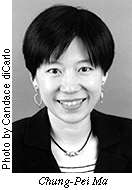
- Chung-Pei Ma, assistant professor of physics and astronomy in SAS, who is exploring the formation and evolution of galaxies and also the computation of temperature variations imprinted on the cosmic microwave background radiation for a "snapshot of the infant Universe" ;
- Tony Pantev, assistant professor of mathematics, whose interests include complex algebraic geometry, Hodge theory and motives, and mathematical physics and string theory; and
- Mary Pugh, assistant professor of mathematics, whose current work centers on fluid dynamics and non-linear differential equations.
NSF 'Early Career' Award Winners
 |
 |
|
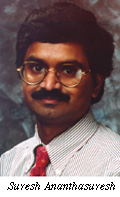
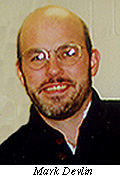
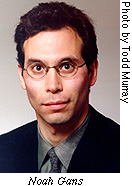
Seven NSF 'Early Career' AwardsYoung scholars at Penn won seven of this year's National Science Foundation's Faculty Early Career Development Awards, given for excellence in engineering and science. Winning seven out of 338 awards puts Penn in a tie with four other institutions for sixth in the nation (the others are UC/Berkeley, MIT, Texas Engineering Experimental Station, and Wisconsin/Madison.) Winning more than seven were Illinois/Urbana with 12, UCLA 11, Michigan 10, and UC/Davis and Purdue, 9 each. The NSF awarded a total of $80 million in the program, which supports scholars who are committed to the integration of research and education. Penn's recipients and the areas in which they were recognized by NSF are:
|
 | |
 | ||
And in the NRC Pipeline...
...Late in the week the National Research Council announced its 111 fellowships designed to increase the presence in the future of faculty members from underrepresented minority groups--and two of these were won by Penn graduate students:
- Jason M. Wingard, communication, is a 1999 NRC Graduate Fellow; and
- Javier F. Barrios, Spanish history, is a Dissertation Fellow.
Almanac, Vol. 45, No. 22, February 23, 1999