
Twelve House Deans for the College Houses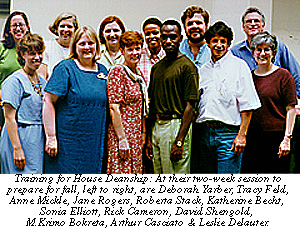
The Office of College Houses and Academic Services has appointed twelve House Deans to provide administrative leadership and coordinate the delivery of academic services for the 21st Century College House system at Penn. The House Deans are key players in the newly implemented administrative structure for the College House system that officially begins this fall.
A search was conducted earlier this year that drew applications from across the country. All candidates were reviewed by an appointment committee comprised of faculty, staff, and students and chaired by professor David Pope. Members of each House then interviewed candidates who possessed high levels of academic achievement, relevant experience either at Penn or comparable institutions, and strong leadership skills.
Professor David Brownlee, Director of the Office of College Houses and Academic Services, said he is extremely pleased by the candidates who were selected to launch the program's inaugural year. "No team of leaders could bring together more talent and experience than the new House Deans. Working with them has already been a pleasure for us, so the students can look forward to a strong start for the College House system."
Throughout July and August, the House Deans underwent two weeks of intensive orientation to prepare them for their roles in helping to build supportive communities for College House students, staff and faculty, according to Executive Director of College Houses, Dr. Christopher Dennis. "Individually and as a group, they constitute an important new resource for the University and will work closely with partners in the schools and resource centers to provide students with front-line advising and support," he said.
Profiles of the House Deans
The first House Deans for the restructured College House System are, in alphabetical order by House name:
Community House: Rick Cameron, a Ph.D. candidate in the clinical child psychology program at GSE, took his undergraduate degree in music in 1982 at Jackson State University, founded and directed an independent Montessori academy in Jackson, and then resumed higher education with an Ed.M. from Harvard in counseling processes (1994). For the past two years he has been program director of the Arts Residential Program in Harnwell House. A former Fontaine Fellow here, he is also a Pennsylvania Psychological Association Book Award winner whose research focuses on issues of cultural expression and the relevance of traditional psychotherapy paradigms for non-majority groups. He has been heard as a soloist in England and Germany and on National Public Radio in this country, and he continues to perform with the University of Pennsylvania Choir and to present a yearly recital at the Annenberg Center.
W.E.B. Du Bois College House: Sonia Elliot, who took a B.A. in English here in 1990 and will shortly receive her M.A. in education from GSE, began her professional career at Penn as associate director for minority recruitment in the Office of Undergraduate Admissions in 1990. She also served in 1994-95 as acting director of the West Coast Regional Admissions Office, recruiting students from California, Hawaii, and Alaska. She is currently working on two research projects with Dr. Howard Stevenson, the Du Bois Faculty Master: "Role and Controversy of African-American Theme Houses on University Campuses: History of W.E.B. Du Bois College House," and "Scaling the Ivory Tower: Adjustment of African-American University Students from Independent Schools. Report on the impact of independent school experience on college choice of African-Americans."
Wendy and Leonard Goldberg College House: Jane Rogers took her B.S.Ed. in 1969 and and M.A. in higher education in 1971, both from Ohio State. She also earned a J.D. from Golden Gate University's School of Law (1976) and spent seven years as a faculty member and administrator at the Syracuse University College of Law. She came to Penn on a Dean's Fellowship to pursue a Ph.D. in higher education; her primary focus of research concerns management prerogatives in the reassignment of tenured faculty. Ms. Rogers expects to complete her Ph.D. in 1999. Well acquainted with residential life at Penn, Ms. Rogers has been an assistant dean for residence at one of the first-year houses since 1990. She continues her work as a litigation and education consultant for clients across the country.
Gregory College House: David Shengold, who took his B.A. in Russian from Amherst in 1981 and an M.A. in comparative literature from UC/Berkeley in 1993, expects to complete his Ph.D. in Slavic languages and literatures from Berkeley next year. Mr. Shengold studied at the Leningrad State University in 1980 and has returned there frequently on research and teaching exchange programs. He has taught at Berkeley, at Mount Holyoke, and at Williams College in Massachusetts. A frequent conference participant in several Slavicist professional associations and the Modern Language Association, Mr. Shengold has published in the Slavic Review and Theatre Journal, among many professional activities. His primary research interests include the Russian literary perception of the United States and the relationship between nationalism and opera.
Hamilton College House: Roberta Stack, who received her B.A. in English from Marymount Manhattan College in 1989, took her A.M. in English at Penn in 1991 and expects to complete her Ph.D. this year. She has been actively engaged in teaching and advising in the English department since 1989, and has served as a faculty fellow at Hill College House for the past three years. She was also assistant to the director of the Penn-in-London program at King's College, London, in 1992-93. A member of Actors Equity as well as the MLA and other scholarly organizations, Ms. Stack has won numerous awards including a Mellon Dissertation Fellowship at Penn (1993-94) and the SAS Dean's Award for Distinguished Teaching at Penn in 1996. Her research interests include Restoration theatre and opera, theatre history, travel narratives, the libretto as literature, film and the novel, and performance studies.
Harnwell College House: Dr. Leslie Delauter holds three degrees from Berkeley (B.A. in comparative literature, 1985; M.A. in English, 1990, and Ph.D. in English, 1997). Her area of specialization is 19th Century American literature and her scholarly interests include the supernatural, religion, social reform and uto-pianism. Among Dr. Delauter's honors are Berkeley's 1993 Outstanding Graduate Student Teaching Award in English; a Mellon Dissertation Fellowship both in 1992 and 1995-96; and a Library Company of Philadelphia Research Fellowship in 1996. Dr. Delauter has taught at Berkeley and at Swarthmore College. At Penn, she has been active with the Writing Program and in Special Collections at Van Pelt Library where she has been processing original manuscripts. Philadelphia history and culture, cooking and food practices, Eastern meditation practices, community service and alternative health care are among her many interests.
Harrison College House: Dr. Arthur Casciato received a B.A. in 1975 from Wheeling College, an M.A. from Virginia Tech in 1978, and a Ph.D. from the University of Virginia in 1985. A former associate professor of English and faculty associate in American studies at Miami University of Ohio, Dr. Casciato has written on Theodore Dreiser, William Styron, and the literature of the Vietnam War. He has also served as director of graduate studies and graduate placement at Miami University. He was the co-founder and book review editor of American Literary History. He was one of the senior editors the University of Pennsylvania Press edition of the writings of Dreiser. He is also the co-editor of two books, Waiting for Nothing and Other Writings by Tom Kromer (U. of Georgia Press 1986), and Critical Essays on William Styron (G.K. Hall 1982). Dr. Casciato has also written numerous articles for such journals as American Literature and Virginia Quarterly. Currently, he is preparing an annotated edition of Tom McGrath's long poem "Letter to an Imaginary Friend."
Hill College House: Tracy Feld received an A.B. in English from Penn in 1990 and as a Thouron Fellow went on to Lancaster University in England for a 1991 M.F.A. with Distinction in Creative Writing. Her literary scholarship focuses primarily on short fiction, and her short stories and essays have been published both in America and abroad. From 1992 to 1995, she was the assistant director of the Philadelphia Young Playwrights Program while also serving as a volunteer editor for the Thouron Newsletter. Ms. Feld has taught writing and critical thinking courses at Community College of Philadelphia and, for the past four years, served as both senior administrative fellow and assistant dean in residence of Hill College House. She is a member of the Anna Crusis Women's Choir of Philadelphia and is fluent in German and American Sign Language.
Kings Court/English College House: Dr. M. Krimo Bokreta, who received three advanced degrees in geology at the University of Algiers in the 1970s, completed his Ph.D. in geology at Penn in 1992. He has held two National Council for Research Fellowships in Italy (1986 and 1989) and a Research Fellowship from the Geology Institute of Poland (1975). Dr. Bokreta has been closely involved with residential housing, academic programs and advising at Penn since 1985, and since 1990 he has been assistant dean for residence at Kings Court/English House, where he was instrumental in building four model living-learning programs. In addition to publishing on minerals, he is co-author of a recent paper in the IEEE Catalog #97CH36099, 1997 based on a presentation he and Penn colleagues made at the 1997 Frontiers in Education conference in Pittsburgh, "The Partnership Between the Science and Technology Wing and the School of Engineering and Applied Science: An Experiment in Living and Learning."
Spruce College House: Deborah Yarber, who graduated from Wake Forest University in 1993 with a B.A. in history, worked in banking for several years and then took an M.Ed. in higher education administration at Vanderbilt, where she was part of the residential living system of Davidson College. Now enrolled in the higher education program at GSE, she has been assistant dean in residence at Spruce College House since 1997. Among her civic projects are community projects such as Cities in Schools, which provided tutoring and mentoring for high-risk students in the Charlotte/Mecklenburg area, and Pathways for Action, a 1996 conference she helped to organize through the League of Women Voters in the same region. Ms. Yarber also worked closely with the SPEAK program at Vanderbilt, a student peer facilitators group that promoted education, multicultural awareness and knowledge. Currently, she is involved in the Penn VIPS Workplace mentoring program at the Turner and Shaw Middle Schools.
Stouffer College House: Anne Mickle was a double major in history and government at Connecticut College where she completed a B.A. in 1989. Her 1990 M.A. in student personnel administration from Teacher's College of Columbia University was completedwhile working in admissions at Columbia College. With a dissertation analyzing the psychological development of college student-athletes, she is now completing her Ph.D. in higher education administration at the UMass, Amherst, where she was residence director in 1992. Ms. Mickle has also served as the director of residence life and commuter affairs at the University of Bridgeport, 1992-93, and for three summers she was manager of operations at the Boston University Tanglewood Institute for high school and college students studying music and visual arts.
Ware College House: Katherine Becht is
a Penn alumna who took both her A.B. and an A.M. in English in 1988 with
honors. She received the Phi Kappa Sigma Literary Award for Best Original
Work of Fiction in 1986, and is a member of the Alpha Sigma Lambda Honor
Society. From 1983 to 1986, she was an editorial assistant at Coopers &
Lybrand in Philadelphia. She was also in academic administration at Widener
University and Neumann College (she also taught as an adjunct lecturer in
English and education) until some seven years ago she joined Penn's School
of Engineering and Applied Science to advise undergraduates and graduates,
and to serve in liaison to faculty advisors. Ms. Becht is a member of the
University Retention Committee that was convened during 1997-98 to identify
and establish support mechanisms for students at risk.
Almanac, Vol. 45, No. 2, September 8, 1998
| FRONT PAGE | CONTENTS | JOB-OPS | CRIMESTATS | BETWEEN ISSUES | SEPTEMBER at PENN |