
 |
|
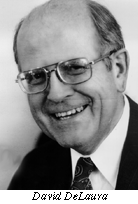 SAS Abrams Awards to Dr. DeLaura, Dr. Mele
Dr. David DeLaura of English and Dr. Eugene Mele of Physics are the 1998 winners of the Ira Abrams Memorial Award for Distinguished Teaching, given annually for teaching that is "intellectually challenging and exceptionally coherent..." to faculty who "are expected to embody high standards of integrity and fairness, to have a strong commitment to learning, and to be open to new ideas."
Dean Samuel Preston will give a reception later this month in honor of the Abrams Award winners and those who won the School's first Kahn Awards.
Dr. DeLaura, who came to Penn in 1974 as the Avalon Professor of English, is an influential scholar of Victorian literature with four books and over 75 papers and monographs who, in the words of one of his nominators, has "excelled in both undergraduate and graduate teaching..." and "still deeply committed to intellectual questioning" after 38 years in teaching. (A graduate of Boston College with his Ph.D. from Wisconsin, he began as an instructor at the University of Texas in 1960 and rose through the ranks to full professor there in 1968.)
Along with his classroom teaching, conducting independent studies and
directing dissertations, he also served as the department's Placement Officer
during most of the 'eighties--before that role had the computerized support
since created by Career Planning and Placement. As department chair in 1985-90
he was regarded as a builder of a "new balance" of excellence
in scholarship with excellence in teaching. From 1993-1997 Dr. DeLaura also
served as the University  Ombudsman.
Dr. Eugene Mele, professor of physics, was an NSF Foundation Graduate Fellow at MIT, where he took his Ph.D. in 1978. After three years with the Xerox Webster Research Center in Webster, NY, he joined Penn as assistant professor of in 1981, became an Alfred P. Sloan Foundation Fellow in 1983, and was promoted to associate professor in 1985.
A full professor since 1989, he has worked on electronic and structural properties of condensed matter, on theory of organic conductors and synthetic metals, and on collective electronic effects, magnetism and superconductivity in novel materials. Most recently he has been working on the physics of carbon nanotubes.
While publishing continuously, a nominator notes that he has for some time given special attention to undergraduate courses, where he wins consistently high ratings. Students ranked his General Honors (170-71) at an average of 3.9 for the four years he taught it. Undergraduates and graduates alike praise his efforts, and he is especially associated with conveying well the kind of material that could leave many "overwhelmed...lost, frustrated"--but instead earns him commendations for "the thorough preparation, the high standards, the clarity of the lectures, the diffuculty and challenge, and how much the learned and benefited from the courses." The summation: "a truly outstanding teacher... dedicated...inspires his students, and in many cases turns them on to a subject that they otherwise considered enormously difficult."
The Kahn Award: Music and Psychology
Last year when the new Kahn Professorship for Faculty Excellence was established at SAS, in honor of the late Edmund J. and Louise W. Kahn, Mrs. Kahn's bequest also created a new kind of prize for the School: a $6000 annual award for a department, undergraduate program, graduate group or center that demonstrates "extraordinary collective faculty commitment to teaching, curriculum innovation, and service to students."
This year, Dean Samuel Preston announces two undergraduate programs as winners of the first Kahn Awards for Educational Excellence:
Music, chaired by Dr. James Primosch with Dr. Norman Smith as undergraduate chair-for first-rate teaching, a rich curriculum, and flexibility in meeting the needs of students-not only of its majors but of the many undergraduates who embrace music en route to careers in medicine, law and other fields.
Psychology, chaired by Dr. Robert Seyfarth with Dr. Michael Kelly
as undergraduatae chair: Along with praise for teaching and advising, the
psychology department was cited in student and alumni letters for the solid
research opportunity given to undergraduates, and for such innovations in
faculty/student interaction as the Undergraduate Psychology Research Fair
and a departmental graduation ceremony.

Nursing Awards: Dr. Spatz, Dr. Sochalski
Dr. Diane Spatz is the winner of the School of Nursing's Faculty Teaching Award for 1998, and Dr. Julie Sochalski has won the School's Undergraduate Advisors Award.
Dr. Spatz, assistant professor of nursing here since 1995, teaches in the Health Care of Women and Childbearing Family division, with a primary focus on undergraduate education. She is a co-investigator on a National Institutes for Health research project, Breastfeeding Services for Low Birth Weight Infants--Outcomes and Costs, currently being conducted at the School.
In nominating Dr. Spatz, students acknowledged her "relentless encouragement and her genuine dedication to undergraduate education and nursing research," and described her as an "extraordinary role model with a passion for teaching nursing students." She is the author of numerous articles focusing on the delivery of health services to high-risk, vulnerable populations, and has also been honored by several professional organizations for outstanding nursing practice, research and teaching.
 The Advising Award winner, Dr. Sochalski, is associate professor
of health services research and assistant director of the Center for Health
Services and Policy Research. She is also faculty advisor for the School
of Nursing's new Nursing and Health Care Management Joint Degree Program
with the Wharton School.
The Advising Award winner, Dr. Sochalski, is associate professor
of health services research and assistant director of the Center for Health
Services and Policy Research. She is also faculty advisor for the School
of Nursing's new Nursing and Health Care Management Joint Degree Program
with the Wharton School.
In nominations she was cited for her "willingness to go above and beyond to make sure that I have an enriched, challenging experience here at Penn," and praised for "the respect, understanding and encouragement she provides each and every one of her advisees."
Dr. Sochalski's extensive research portfolio and publications cover issues on the implications of health systems reform for nursing workforce and patient outcomes in both domestic and international arenas. She came to Penn in 1997, and was a Robert Wood Johnson Health Policy Fellow in the Office of Senator Bill Bradley from 1992-93.
Almanac, Vol. 44, No. 29, April 14, 1998
FRONT PAGE | CONTENTS | JOB-OPS | CRIMESTATS | BETWEEN ISSUES | APRIL at PENN