Front Page
CONTENTS
Job Ops
CrimeStats
Between Issues
Benchmarks
PULLOUT: March at PENN 1998 Calendar
A Primary Care Database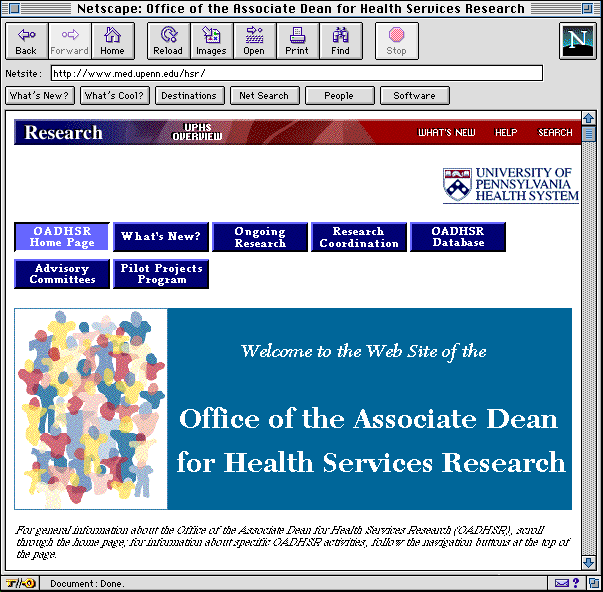
A new information system is available to provide researchers with comprehensive, cross-sectional, and longitudinal view of health care delivered throughout UPHS.
According to Dr. Alan L. Hillman, associate dean for Health Services Research at the School of Medicine, the database integrates patient information from many of the computer systems within UPHS, and can assist researchers in all phases of their work, from generating hypotheses to preparing grant proposals to conducting patient-oriented research.
The new database is the first in the Penn Health System to integrate data from IDX (the scheduling and billing system used by all CPUP and most CCA practices) with the HUP inpatient medical records database.
The database also includes most HUP laboratory data (both inpatient and outpatient), cardiac catheterizations, emergency department visits, and pharmacy data (currently pharmacy data is available on a subset of the Health System population). Data from other clinical departments will be integrated in the next few months. The database now contains demographic and diagnostic information on more than 180,000 patients and more than 1.5 million visits to primary care clinics and the HUP emergency department since January 1994. Also, it contains information about more than 68,000 patients involved in more than 100,000 HUP admissions. More than 14,000 patients in the primary care population have at least one admission.
The database can facilitate retrospective case-control and cohort studies, and can track patients prospectively for randomized controlled trials. When developing proposals for external funding, researchers can quickly ascertain whether an adequate sample of patients with certain characteristics or diagnoses exists within UPHS.
As UPHS moves toward an electronic ambulatory medical record, discrete elements of the history and physical exam will be integrated. Identifying patients for research will be easier, and less time will be devoted to abstracting charts manually. In the near future, the database will include functional status measures as well. The availability of clinical and administrative data, plus functional status measures on the same patients, will greatly enhance outcomes research throughout UPHS.
Dr. Hillman and his colleagues are ready to assist UPHS researchers in using the new database. Depending on the level and term of assistance, a fee may be assessed to cover this service. For more information, please call Mark Weiner, at (215) 898-5721.
--From a Penn Health System News Release
Return to:Almanac, University of Pennsylvania, February 24, 1998, Volume 44, Number 23