To the University Community
The Agenda for Excellence sets the goal of increasing the number of sponsored research awards received by Penn faculty. To build the foundations for achieving this goal, the administration has undertaken to improve the support provided to Principal Investigators through a re-engineering of research administration and research accounting processes. We seek to streamline pre-award procedures and to improve both the services and the quality of information provided to PIs after awards are received. We think the improvements in the model proposed by the re-engineering task force will make Penn and its faculty more competitive for extramural research funding than they are now. The proposed model reflects the views that faculty and administrators expressed in extensive surveys and focused interviews. The model also contains innovative proposals to facilitate faculty research programs while assuring adherence to sponsor requirements and University policy. We invite your comments on the model and ask that you forward your remarks to RESADMIN@pobox.upenn.edu.
-- Stanley Chodorow, Provost, and John Fry, Executive Vice President
The Research Administration Reengineering Team was charged with reengineering the University's sponsored projects support process. The goal was to produce a radical redesign of the process, including technology requirements and a redesigned organizational model, to make the most effective use of resources and to improve service to principal investigators. The process was defined to begin with identifying funding sources and end with close-out of the sponsored project.
Following a project plan delivered by Coopers & Lybrand, LLP, the Team studied the work of previous quality and process management teams. The Team gathered data from principal investigators (PIs), business administrators (BAs), central office staff, sponsors, and others to design a new sponsored projects support process. The process will provide improved information and service to PIs, while reducing the number of reviews without increasing risk to the institution.
The proposed sponsored projects support process is dependent on the development of a comprehensive information system which will support enhanced service delivery by the proposed Research Services organization. Virtually all of the recommendations made by the Team will be realized only through the implementation of this comprehensive information system. Improvements and savings will be realized and maintained by instituting thorough and ongoing training for PIs and BAs. Following, are highlights of the proposed model:
Key benefits of the new sponsored projects support process include:
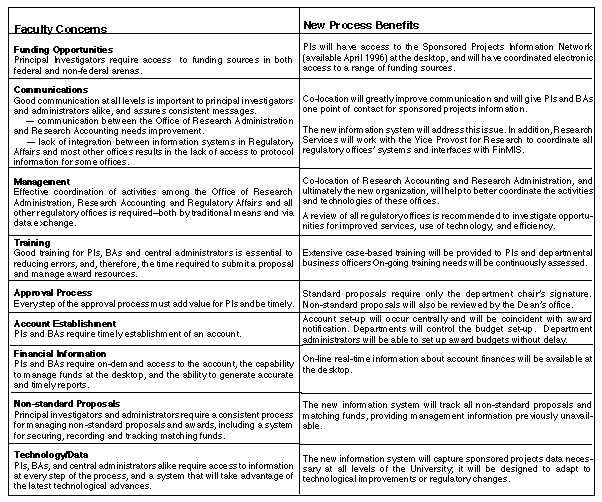
The benefits listed above will be the results of improvements to the process made in response to the faculty survey conducted by the Team. Of the 1266 identified active investigators, 341, or 27% responded. Because of the strong response and its correlation to information collected in faculty focus groups, the Team is confident that the table below represents faculty concerns and their solutions.
The Coopers & Lybrand study identified the sponsored research support process as one ripe for radical redesign, with the goals being improved service to faculty, and cost and effort reductions for schools and the central administration. It is important to note that Coopers & Lybrand did not identify this process for redesign due to its failures; rather, because recent technological advances would allow for the development of a world-class sponsored projects support process. The model proposed by the Team meets these goals.
Following a project plan designed by Coopers & Lybrand, the Team defined the current process, gathered data on the functionality of the current process, and redesigned the process, including defining technology requirements and modeling the organization supporting the new process. The Team took advantage of information and data gathered by previous Total Quality Management (1990-1991) and Process Improvement (1992) teams during their assessment of the current process. Current process flow diagrams, organization charts, and job descriptions were analyzed for value to the customers (principal investigators, school administrators, and central office administrators). An intensive, three-month data collection phase followed this analysis and included:
The process redesign was done by the Team and presented to Steering Committee members, deans, and key faculty and administrators for feedback. After incorporating the feedback, the Team formed sub-teams and worked simultaneously on identifying technology requirements, developing an alternative organizational model, and conducting a cost/benefit analysis.
The process to be analyzed begins with identifying funding sources and ends with close-out of the award. In order to facilitate communications, the Team grouped activities into seven steps:
The steps in the process for preparing sponsored research proposals and managing the awards do not radically change; rather, radical change in the methods by which these steps are performed, and in the roles which principal investigators, business administrators, and central administrators play, are desirable. Proposed changes include:
An explanation of the benefits of the proposed model follows.
Identifying Funding Sources:
Prepare Proposal:
Review/Approve Proposal:
Submit Proposal:
All parties will be notified electronically of University approval.
Research Services maintains only a portion of the proposal (abstract, budget, transmittal form) in its central file, thereby reducing file space required in Research Services and reducing file maintenance costs.
Negotiate/Accept Award:
Negotiation will include the PI and any other pertinent parties, for instance the Center for Technology Transfer and the Office of General
Counsel.
Set Up Account:
Account set-up will occur centrally and will be coincident with award notification.
Manage Project Resources:
All regulatory offices (Regulatory Affairs, Environmental Health and Safety, University Laboratory Animal Resources, Radiation Safety)
will have coordinated home pages, allowing access to information at the PI's desktop.
Close-out and Reporting
Electronic notification to PIs of reporting and close-out deadlines.
General Benefits
Consistent assistance and service by Research Services.
Key Functional Requirements
The Reengineering Team identified several key functional requirements for sponsored projects information systems:
Electronic Interaction with Investigators and Business Administrators
Facilitate communication with the University research community by initiating or using news groups and electronic mail.
Desktop Access to a University-wide Sponsored Projects Database
A new sponsored project information system will require an investment in new software and hardware. The software must include a new database containing the information plus software to access and manage that information. Key capabilities of this information system include:
During the implementation phase of this project, it will be determined which of these requirements have not already been accommodated by FinMIS.
Provide ad hoc Access to Sponsored Project Information
MIS Requirements
Access
Desktop Computing Hardware Requirements
Software Choices (specifically as applied to applications servers)
Research Services will not simply be a processing organization. Research Services will be a partner of the principal investigator, department and school administrators, and other regulatory offices (Regulatory Affairs, Environmental Health and Safety, University Laboratory Animal Resources, Radiation Safety, and the Center for Technology Transfer), lending expertise, providing information, and continually improving service. Teams of Research Services staff will form relationships with groups of faculty to improve service delivery at every step of the process and to exchange knowledge about the process, sponsors, and other aspects of sponsored projects support. Teams will be cross-trained in order to maintain a high level of service and a commitment to meeting sponsor deadlines during peak periods or proposal submissions.
The functions performed by the Federal Compliance group; e.g., indirect cost negotiations, effort reporting and the coordination of all audit activities, will remain a part of the Comptroller's Office. Complete and timely communication and exchange of information must be maintained among and between the Federal Compliance and Research Services staff.
Research Services will be a new service organization, the foundation of which is the delivery of the sophisticated information systems described above. The principles upon which the organization is based call for new positions and job skills. The Implementation Team will work closely with the Division of Human Resources as appropriate during the transition. The Reengineering Team proposes the following positions based on its research to date:
During the redesign, the Team noted the history of high employee turnover in Research Accounting. The skills, knowledge and experience of the personnel in both Research Accounting and the Office of Research Administration are valued and necessary for the delivery of excellent service to the University. Staff in these areas often are hired by the schools for their skills at comparatively higher salaries putting the central offices at a competitive disadvantage.
While there is a certain comfort in knowing that qualified staff with accounting skills and knowledge of federal regulations are in place in schools and centers, their short tenure in the central offices causes workflow disruptions and contributes to the backlog of unclosed accounts.
The new Research Services organization addresses the skills necessary university-wide to administer sponsored projects, and emphasizes the role of Research Services in training and education. This provides broader job responsibilities and career opportunities and enhances the central offices ability to retain well-trained and service-oriented staff. The objective is to make team members feel that they are part of the University's research enterprise and that they are inextricably linked with individual faculty members and schools competing for sponsored projects. Individuals in Research Services will be critical to the University successfully meeting its goals for sponsored research activities dollars and numbers of grants, or market share.
The size of the new organization will be determined during the transition phases according to results of process changes and the implementation of technology.
The Research Accounting Department is part of the Comptroller's office. Salary expenditures with benefits in FY95 were $605,416.
The Research Accounting Department has traditionally experienced a high employee turnover rate, however, the problem has become acute over the past three years. The reasons for the high employee turnover are: low employee compensation as compared to higher salary structures available in the schools for comparable positions; limited opportunity for advancement within Research Accounting; and the attractiveness of the staff to academic departments with research programs once trained in sponsored project accounting and billing requirements. The results of high turnover are:
The proposed Research Services model has been designed to address these problems by providing appropriate compensation, training, and opportunities for advancement within the organization.
Research Administration
The Office of Research Administration reports to the Vice President for Finance and the Vice Provost for Research. Staff headcount has remained essentially static despite a 28% increase in the number of proposals submitted from FY 90 to FY95. Salary expenditures with benefits in FY95 were $825,329.
Regulatory Affairs
The Regulatory Affairs office has seen a significant increase in protocol reviews over the past three years due to regulatory changes. The Reengineering Team designed the new process and organization, and The Implementation Team may wish to consider several structures when making its final recommendations, two of which are outlined below:
It is recommended that the Research Accounting Department and the Office of Research Administration be co-located as soon as is practical. Co-locating the two offices will enable the resulting "transition organization" to take the necessary steps toward the proposed Research Services organization.
The initial co-location will provide a number of benefits during transition to the new Research Services model, including:
New Organization
The full impact of the introduction of FinMIS on July 1, 1996, as well as other variables during the transition period, have made it difficult to recommend a detailed new organization and its various transition stages. FinMIS is expected to affect work processes and workflow in both central and school/department offices; however, changes in the amount and type of work performed have been difficult to predict in most administrative areas.
Opportunities for service improvements and/or economies discovered by the Implementation Team, impacts of regulatory changes, impacts from increases/decreases in the number of proposals or awards, and new technological advances during the transition period may all have an effect on the transition process and the final Research Services structure.
Given that Research Accounting and the Office of Research Administration collectively make up only 22% of the total budget spent centrally on Sponsored Projects support, it is recommended that the other central offices involved in the process of research administration be reviewed. These offices are the Center for Technology Transfer, Radiation Safety, Environmental Health & Safety, University Laboratory Animal Resources, and the Office of the Vice Provost for Research. A review of these offices, conducted concurrent to implementation activities, should investigate the following:
Plan and Allocate Resources to Close Outstanding Sponsored Project Accounts
The issue of outstanding sponsored project accounts needs to be addressed. Although Research Accounting has made some headway with the large number of accounts which are overdue for closure, they have not had adequate staffing or resources to address the backlog.
A separate team needs to be assigned to develop a "close-out plan" which should include the following:
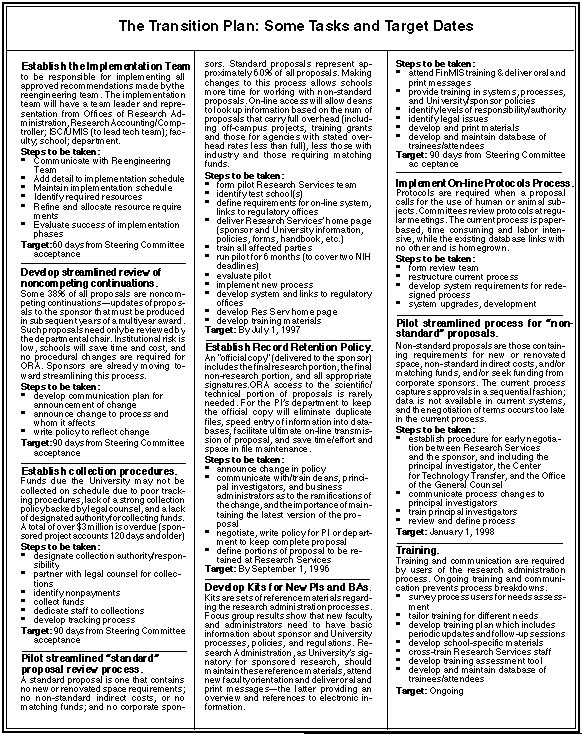
The Team expects the transition from the current process and organization to the proposed process, technology and organization, to begin approximately sixty days after approval of the final report and to continue through calendar year 1998. Ongoing involvement of PIs and appropriate members of the University community is anticipated. Opportunities to pilot new organizational strategies and processes will be investigated. Details regarding certain implementation steps and estimated resources required are listed in the chart below. Specific transition steps include, but are not limited to:
Research Administration Reengineering Team
* The Team recognizes the need to consider the development of these positions in light of overall Division of Finance efforts related to training and technology.
Almanac Supplement
Almanac
Volume 42 Number 32
May 14, 1996
Return to Almanac's homepage.
Return to index for this issue.