Penn’s Climate Action Plan 2.0 |
|
, |
A Message to the Campus Community on The Launch of Climate Action Plan 2.0
Executive Summary
A Message to the Campus Community on The Launch of Climate Action Plan 2.0
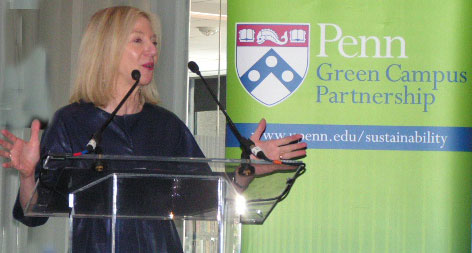 |
| Penn President Amy Gutmann announcing the launch of Penn’s Climate Action Plan 2.0 |
The University of Pennsylvania launches Climate Action Plan 2.0, a renewed vision of our environmental stewardship. It has been five years since the launch of our original Climate Action Plan—five years since we embarked as a community on our mission to expand sustainability in our curriculum and reduce our carbon emissions. In that time, we have had extraordinary successes.
Through the hard work of the University’s Schools, Centers, Senior Leadership and Environmental Sustainability Advisory Committee, Penn’s carbon emissions have decreased 18%, a significant collective achievement. Our recent campus additions are showcases of integrated environmental design, with six new LEED-certified buildings and groundbreaking new open spaces. Penn is demonstrating best environmental practices across campus, reducing auto emissions from commuters, instituting green purchasing to keep pace with the needs of the Penn community and maintaining our beautiful 280-acre campus without chemical fertilizers and pesticides. Most important, through the expansion of course offerings and research on sustainability, our students and faculty are collaborating to integrate knowledge across a variety of disciplines and engage the urgent environmental issues of our time.
The environmental challenges facing our University and our planet are bringing out our best, reflecting Penn’s passion to impact our community, country and planet through our commitment and shared expertise. Climate Action Plan 2.0 will help us continue to advance our efforts to reduce emissions and expand knowledge in theory and practice:
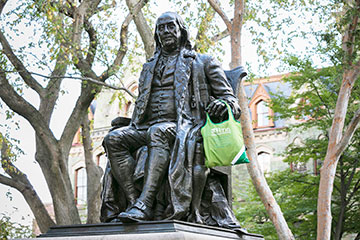 |
| Even Benjamin Franklin has officially Gone Green! |
• Penn’s Century Bond program is the definition of a forward-looking capital investment strategy, increasing building efficiency while improving the performance of programmatic spaces for teaching, research and study.
• Sustainability Coordinators, appointed by Schools and Centers, are providing a model of creative advocacy, implementing highly visible, replicable and impactful initiatives across campus.
• Student environmental leaders in College Houses, Athletics and Greek communities are challenging conventional wisdom and ensuring that our entrepreneurial, proactive student body continues to think globally and act locally in every aspect of their life at Penn.
• The recently established Kleinman Center for Energy Policy will lead the nation in creating strategies and programs for a clean-energy economy.
Our new goals, described in full in the Climate Action Plan 2.0 report will challenge us to achieve even greater success. To see highlights of our accomplishments and plans for ongoing work, view the video Penn’s Climate Action Plan: Creating a Culture of Sustainability at: http://youtu.be/l438Wr92qBo
We are grateful to all members of the Penn community for joining us in this essential endeavor to help protect the future of our global community, and we look forward to the further accomplishments of the Climate Action Plan 2.0.
—President Amy Gutmann
—Provost Vincent Price
—Executive Vice President Craig Carnaroli
 |
 |
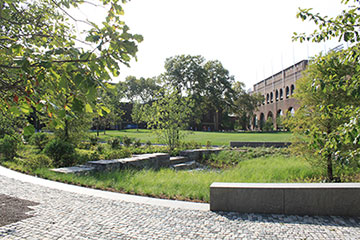
| The rain garden—one of many environmentally sustainable elements in Shoemaker Green—improves storm-water management for Penn and Philadelphia. |
Sustainable actions of individuals become the impact of a community. |
Executive Summary
Five Years of Progress
Five years since the launch of the University’s first Climate Action Plan, Penn looks back on a remarkable and steadily deepening array of accomplishments and forward to a path of continual improvement in its ecological performance. In 2007, as the first Ivy League signatory to the American College and University Presidents’ Climate Commitment, the University began the process of creating and executing a vision of environmental sustainability at Penn.
In 2009, the launch of the Climate Action Plan set concrete goals and began the formal process of integrating sustainability into coursework, community, campus planning and design and campus operations. Significant progress has been made and accelerating momentum established. Below is a review of the main objectives by the numbers:
• Bolstering the Curriculum—Penn now offers over 170 courses focused on and related to sustainability, and the Integrating Sustainability across the Curriculum program added 22 faculty and 12 students who have collaborated to infuse principles of sustainability into 21 courses.
• Reducing our Carbon—Penn achieved an 18% reduction in its carbon emissions from FY 2007 to FY 2014, and also achieved a 6.6% reduction in normalized energy consumption.
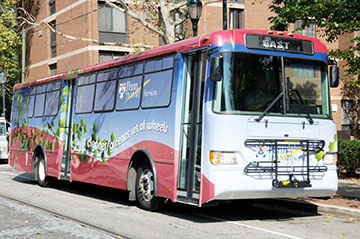 |
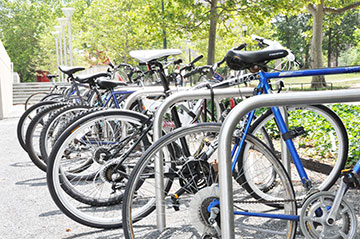
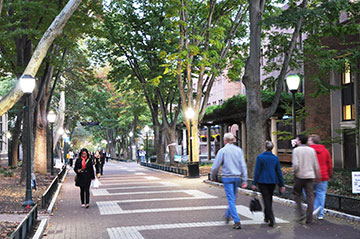
| Low emission Penn buses and spaces for more than 5,000 bicycles on campus help reduce emissions. Led lights illuminate Locust Walk (below). |
• Growing Greener—As a major research university Penn meets its mission of teaching and research with new facilities. But the Climate Action Plan focuses that growth to be more sustainable, resulting in six new buildings achieving LEED Gold Certification and more than 27 new acres of green space.
• Minimizing Waste—Penn recycles nearly 26% of its waste, including traditional recycling, composting and e-waste and educates our community about the importance of decision making in what products they consume. Penn’s continued reduction of landfill waste by almost 10%, provides a more complete picture of waste minimization on campus.
• Commuting with Fewer Emissions—50% of Penn commuters now use public transit, walk or bike. Our community has witnessed an increase in people using alternative transit by nearly 10%, playing to our strength as a dense campus easy to traverse by foot or bike and well connected by public transit.
• Engaging the Penn Community—Penn’s Green Fund made 49 grants to faculty, students and staff totaling over $1 million over the last five years, and whose ideas are generating cost saving and reducing our carbon footprint. 350 students and more than 100 staff have volunteered as Eco-Reps over the past five years, championing sustainable actions in offices, College Houses, student organizations and athletic teams.
While implementing the initiatives explicitly identified in the Climate Action Plan has been rewarding for the faculty, staff and students who helped create it, the unanticipated outcomes, programs and projects that have evolved through heightened exchange have often been even more profound and exciting. Not only have students, faculty and staff eagerly embraced the initiatives we have undertaken, they have also responded by creating new programs at a rate that was impossible to predict, including:
• PennGreen: Upperclass students who wanted to provide a sustainability-themed pre-orientation program created PennGreen, which in 2014 welcomed its fifth class of freshmen to Penn with a whirlwind of tours, meetings, dialogues and lectures by local experts in environmentalism.
• Move-In Green: Staff in College Housing and Academic Services and Residential Services were essential to the creation and launch of Move-In Green, Penn’s signature New Student Orientation student volunteer opportunity.
• School and Center Sustainability Coordinators: A role not foreseen in the 2009 Plan, seven Schools and Centers are now meeting monthly, sharing their enthusiasm and best practices and implementing projects across campus.
• Penn Green Fund: The success of the Penn Green Fund has exceeded expectations, with funding awarded to College Houses, Greek Houses, Athletics and Recreation, the Morris Arboretum and the University of Pennsylvania Museum of Archeology and Anthropology, among many more.
• The Century Bond Program: The Century Bond Program is investing in energy efficiency in campus buildings at a scale not seen at any other university in America, demonstrating Penn’s commitment to bringing sustainability to the heart of its planning operations.
Development & Format of Climate Action Plan 2.0
Developing a new five year plan, Climate Action Plan 2.0, is an exciting opportunity that builds on such successes, institutionalizes organic change and uses the experience learned from past challenges to better frame new goals and strategies. One of the most ambitious elements of Climate Action Plan 2.0 is the expansion of the Plan’s geography, from the core academic campus, to more fully capture the range of environmental leadership across the University’s entire built assets. By including the University of Pennsylvania Health System, the Morris Arboretum, the New Bolton Center and the University’s leased space and real estate portfolio, Climate Action Plan 2.0 reflects an expanded approach to environmental stewardship and highlights important work accomplished, underway and planned for the future.
The recommendations included throughout Climate Action Plan 2.0 were formalized by the respective Environmental Sustainability Advisory Committee (ESAC) Subcommittees, building upon five years of collective experience implementing the initial plan. ESAC Subcommittees are organized by topic area: Academics, Utilities & Operations, Physical Environment, Transportation, Waste Minimization & Recycling and Outreach & Engagement.
This Climate Action Plan 2.0 document is organized by the above subcommittee initiatives, with each section including a Mission, Five Year Summary and Recommendations.
Climate Action Plan 2.0 Recommendations at a Glance
The recommendations included in Climate Action Plan 2.0 build upon those outlined in the original Climate Action Plan and achievements of the past five years. The carbon and energy goals in Climate Action Plan 2.0 align with the long-term goal of carbon neutrality by 2042, and include the following:
Academics–Expand opportunities for teaching, learning and researching sustainability among students, staff and faculty.
• Create a Faculty Working Group on Sustainability to provide outreach and support to faculty interested in researching and teaching sustainability.
• Promote existing sustainability programs and classes to Penn’s undergraduate and graduate student body.
• Create a Speaker Series/Symposium dedicated to sustainability.
Utilities & Operations—Promote and adopt best practices in energy management, design and maintenance to improve efficiency and reduce Penn’s carbon footprint.
• Achieve Total Carbon Reduction in Buildings (absolute)
• 7% reduction by 2019 in comparison to the FY14 baseline
• 18% reduction by 2042 in comparison to the FY14 baseline
• Achieve Energy Reduction in Buildings (absolute)
• 10% reduction by 2019 in comparison to the FY14 baseline
• 27% by 2042 in comparison to the FY14 baseline
• Recommission the top 20% of the buildings that have the highest energy use every five years and complete a deep energy retrofit by 2042. The remaining 80% of buildings will be recommissioned on a ten year basis.
• Develop an energy reduction plan for all building renovation projects, including basic energy benchmarking for all buildings and energy modeling & analysis of alternatives for major renovations.
Physical Environment—Create and maintain a sustainable campus by increasing green space, decreasing building energy consumption and increasing education and awareness of sustainable design.
• Continue to pursue LEED Silver Certification for all new construction, with focus on “Penn plus” credits, those that are identified as critical to Penn’s environmental initiatives.
• Implement the Green Guidelines for Renovations to provide direction on Penn’s renovation work on modest sized projects, as defined in the Guidelines. Significant renovations that satisfy criteria identified in the Guidelines, including exceeding $1 million, are recommended to pursue.
• LEED Silver Level under the Commercial Interiors (CI) protocol.
• Develop an Ecological Landscape Stewardship Plan that through pilot projects examines how to minimize chemical use, promote biological diversity and incorporates best practices from the Sustainable SITES pilot on Shoemaker Green.
• Extend the Plan’s geography from the core academic campus, to more fully reflect the full range of the University’s built assets, to include the Hospital of the University of Pennsylvania, the Morris Arboretum, the New Bolton Center and Penn’s leased space and real estate projects.
Waste Minimization & Recycling—Improve Penn’s environmental performance by minimizing solid waste through community education, strategic purchasing, appropriate infrastructure and proper disposal, strengthened by relevant and accurate metrics.
• Increase recycling rate, currently approximately 24%, to 30% by 2019, and continue to reduce overall municipal solid waste.
• Implement the Solid Waste Management Plan, including the creation and implementation of a data reporting tool to track waste diversion metrics and improve composting operations on campus.
• Increase participation in and awareness of sustainable purchasing options and recognize green purchasing champions.
• Increase the number of zero waste events and expand composting on campus.
Transportation—Emphasize and plan a quality pedestrian campus environment, encourage use of bicycling and public transportation for commuting and provide safe, efficient local transportation services for the University community.
• Create a centralized online resource for bicyclers on campus, including bicycle rack maps, the University Bike Policy, bike lane maps, etc.
• Continue to replace older bicycle racks with University standard bike racks.
• Expand the number of bike repair stations on campus.
Outreach & Engagement—Build a culture of sustainability that informs all constituents of University life.
• Work with School and Center senior leadership to encourage and expand Sustainability Coordinator roles within all Schools and Centers at Penn.
• Sustain a vibrant Student Eco-Reps program in College Houses, Greek chapters and Athletics that fosters a culture of sustainability among students on campus.
• Maintain a dynamic Staff & Faculty Eco-Reps program as an active and accurate source of sustainability information.
 |
 |
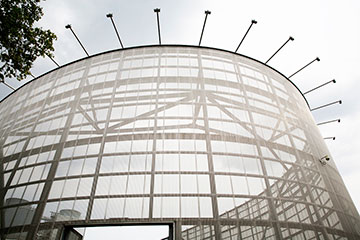
| MOD 7 Chiller allows energy and financial savings from chilled water production and off-peak production of ice. |
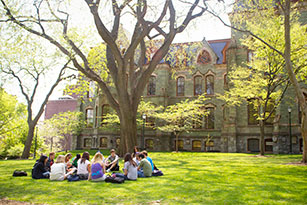
A class meets on College Green near some of the 7,000 trees on campus. |
Leadership & Awards
Since the launch of the 2009 Climate Action Plan, the University of Pennsylvania has been repeatedly recognized by both internal and external audiences for the University’s commitment to environmental sustainability.
• Princeton Review
The University of Pennsylvania has annually been highlighted in The Princeton Review’s Guide to Green Colleges since 2010. This guide profiles institutions of higher education in the US and Canada which exhibit a commitment to sustainability in both the academic arena and university operations. The guide has highlighted Penn Park, the Green Fund and the Student Eco-Reps program over the past five years.
• Tree Campus USA
The University of Pennsylvania earned 2013 Tree Campus USA® designation, awarded by the Arbor Day Foundation. This marks the fifth year in a row that Penn has received this designation. Tree Campus USA® is a national program created in 2008 to honor colleges and universities for effective campus forest management and for engaging staff and students in conservation goals. Penn achieved the title by having an active Tree Advisory Committee, a Campus Tree Care Plan and finance and personnel resources allocated for the Tree Care Plan.
• Sustainability Tracking Assessment & Rating System
In May 2014, Penn submitted its first application to STARS—the Sustainability Tracking, Assessment & Ratings System—and received a Silver rating. STARS is a self-reporting framework of sustainability metrics specifically developed by the Association for the Advancement of Sustainability in Higher Education (AASHE) for college and university campuses. STARS’ standard categories and transparent scoring metrics allow for easy assessment of the University’s performance and future opportunities. Although the STARS ratings last for three years, Penn will update its submission every two years so that content remains relevant and progress can be regularly measured against these defined standards.
• EPA Green Power Award
The University of Pennsylvania finished in first place in the US Environmental Protection Agency’s nationwide College and University Green Power Challenge. EPA defines green power as electricity produced from solar, wind, geothermal, biogas, biomass and low-impact hydroelectric sources, and this program recognizes colleges and universities that purchase Renewable Energy Credits (RECs), which are created through the generation of green power.
EPA began its Green Power Challenge for higher education institutions in 2006, and the University of Pennsylvania has been the Ivy League winner every year since. Penn took top honors nationally in 2013 by purchasing more than 200 million kWh of wind power—more green power than any of the 75 other competing schools.
As part of EPA’s Green Power Partnership, more than 1,400 organizations are purchasing more than 26 billion kilowatt-hours of green power annually, avoiding carbon pollution equal to that created by the electricity use of more than 2.8 million American homes. The partnership provides quarterly updated lists of partners using green power in several other categories including K-12 schools, technology and telecommunications, local government, among others.
• Green Purchasing Award
A Special Recognition Award from Office Depot was presented to Penn at the GreenBuild Conference & Expo, on November 22, 2013 at the Pennsylvania Convention Center, recognizing Penn as an institution that proactively seeks out products with environmental attributes. Office Depot’s Special Recognition Awards are based on specific aspects of a customer’s purchasing program or leadership in greening. For 2013, the University of Pennsylvania was one of 28 organizations selected out of 17,000 Office Depot customers.
• Best Work Places for Commuters
The National Center for Transit Research has named Penn among the Best Workplaces for Commuters for two years in a row, in acknowledgement of the University’s integrated approach to commuting options, which includes discounts for public transit commuters, van and carpooling programs and support of cycling on campus.
• International Sustainable Campus Network
Penn has been a member of the International Sustainable Campus Network (ISCN), which is a part of the Global University Leaders Forum, since 2010. In 2014, Penn’s Integrating Sustainability Across the Curriculum program was included as one of the ISCN’s case studies for the World Economic Forum.
With Climate Action Plan 2.0 as the blueprint, Penn now embarks on another five years of environmental leadership guided by long-term vision and commitment from senior leadership, students, staff and faculty. There is still more to do. We are excited about the next five years of engagement with the Penn community and look forward to our journey together.
The full Climate Action Plan 2.0 is available on Penn’s Green Campus Partnership (GCP) website, www.upenn.edu/sustainability GCP is the umbrella group that addresses environmental sustainability and stewardship, and advocates for enhanced sustainability policies at Penn. It includes ESAC as well as faculty, staff and students. The GCP was formed after President Gutmann signed the ACUPCC in February 2007, the first Ivy League president to do so. For the PDF of the Climate Action Plan 2.0 see http://www.upenn.edu/sustainability/sites/default/files/pdf/Penn%20Climate%20Action%20Plan%202.pdf |