University Council Meeting Coverage |
|
, |
In accordance with the University Council Bylaws, the March 26 Council meeting included “extended reports by the President, the Provost and other administrators covering budgets and plans for the next academic year.” The remarks on these pages were adapted from the presentations given.
There was also a panel presentation and discussion on Diversity at Penn, which was one of this year’s focus topics. The panel consisted of Joann Mitchell, vice president for institutional affairs; Anita Allen, vice provost for faculty; William Gipson, associate vice provost for equity and access; and Sam Starks, executive director of the Office of Affirmative Action and Equal Opportunity.
Dr. Allen reminded Council of the supplements published earlier this academic year in Almanac: Minority Equity Report (Almanac December 10, 2013) and The Progress Report on Penn’s Action Plan for Faculty Diversity and Excellence (Almanac February 4, 2014).
Dr. Amy Gutmann said that “if we continue the momentum it builds a virtuous circle,” in regard to the University’s efforts to be diverse and inclusive.
Reports on Plans and Budget for the Next Academic Year
Strategic Plan for Global Initiatives at Penn
—Ezekiel J. Emanuel, Vice Provost for Global Initiatives
Three Strategic Pillars
It is a pleasure to be here today to talk about where we are in the process of realizing the strategic plan for global initiatives. We have based our strategic plan on three pillars. The first pillar is more engagement of students in the world, both by sending Penn students overseas and by bringing international students here to Penn. The second pillar is to strengthen Penn as a global agenda setter for issues that confront the world. The third pillar is to use our great resources, as a research institution and as an educational institution, to promote healthy and inspiring lives in various parts of the world. We have a number of initiatives under each of these pillars.
Prepare Students for a Globalized Society
We want to strengthen the study of international issues, to develop cross-school and cross-disciplinary programs, and to strengthen our curricular and extra-curricular activities by developing a campus center for global issues. We want to think through how we can develop more activities on campus for our students and how we can bring more students to Penn who have a global perspective. One issue to tackle is bringing more international students to Penn. We can address this issue by raising more money for international students and also bringing the international students who we have more fully into campus life. We are very active on this project. One of my staff members in Penn Global is working with VPUL to do this and to make sure that students from abroad feel at home at Penn and feel like they can fully participate in Penn activities. We hope to broaden their perspective and broaden US students’ perspective as well.
A second initiative is to increase opportunities for students to engage with the world. Nationally, academic year study abroad is declining. One reason is that the opportunities on campus have become so rich.
We are therefore increasing international internships and research opportunities for students to go overseas. For example, our office sponsors a summer internship program for undergraduate and graduate students. When I arrived, we sponsored about 40 internships, and this year we will award about 85 of them. We are fundraising for these opportunities, and we have dedicated more resources from the University for those programs. We have many more students applying for each position as we have positions. This is clearly a very good way to get students to go overseas and have an immersion experience working for a nonprofit or for other organizations. One of the most interesting things about this process is that the proportion of our students on financial aid in the program is higher than the proportion of students overall receiving financial aid at Penn. This is a very good opportunity for students who might not have the resources at home to have an international experience. We are also trying to develop post-graduate programs to permit students to go overseas a year or two after they’ve graduated, either to work for a nonprofit or to get involved with business or other occupations overseas. We are doing all of this, and we are also enhancing our semester abroad programs. We have reviewed each of our programs in the last two years to make sure they meet educational criteria, meet risk criteria, and really give students an immersion experience. We are trying to increase global opportunities for students on all fronts.
Strengthen Penn as a Global Agenda Setter
The second pillar is to make Penn more of a global agenda setter, and the core of this pillar is that we are going to build a World House, a physical structure on campus. This house will be an innovation center that will focus on global issues and bring together faculty, global policy makers and others to begin thinking and writing about solutions to pressing global problems. We also anticipate that the World House is going to be a fulcrum for students and student organizations interested in global activities, as a way for them to have meetings, host conferences, host films, host performers and interact with faculty. The building will have two classrooms, which we hope will be used for courses related to global activities. We think it is going to be a very inviting building for activities. Like many Penn buildings, it will probably be over-subscribed on the day that it opens.
Promote Healthy, Inspiring and Productive Lives
The last pillar is that we will use our great resources here as a research institution and institution of learning to promote healthy lives. We are not a development agency, but we are concentrating on areas where we have a lot of faculty and student interest. China, Southern Asia—including India—and Africa are our main areas. We are interested in Latin America as well. The amount of activity we have on campus related to Latin America is less than the three regions, but we are actively looking for projects and programs that we can promote there. You all know that we are opening the Penn Wharton Center in Beijing next year to coordinate our activities, so faculty and students can have a touchdown space there, and we may also interview prospective applicants as a way of coordinating our activities. My office—through the Global Engagement Fund—funds a number of activities in these countries, mainly trying to facilitate cross-school, cross-disciplinary, cross-faculty and student programs, whether they are research programs, conferences or other ways of engaging.
So this was a brief summary of the strategic plan and where we are in the process, and I am happy to answer any questions.
Q&A
There were a number of questions raised by Council members and a lively discussion ensued.
University Operating Budget
-Bonnie Gibson, Vice President, Budget & Management Analysis
I will be reviewing the FY14 current year budget. The FY15 budget is still being developed and will be presented to the Trustees for approval in June. I will discuss our total charges for FY15.
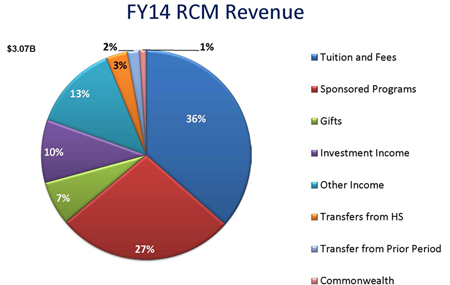
For FY14 we have budgeted $3.07 billion in revenue. There are multiple components of revenue, but the easy way to think about our revenue sources is in thirds. The first, slightly overweighted third, is tuition and fees, representing over $1.1 billion or 36% of our operating revenue. The second, slightly underweighted third, is sponsored programs, or research, representing $842 million or 27% of our revenue. The final third is everything else, representing $1.1 billion or 36% and including the income from our endowment, gifts, other income (mostly sales and services), transfers and support for the Veterinary School from the Commonwealth of Pennsylvania. So as you think of our revenue sources, remember thirds.
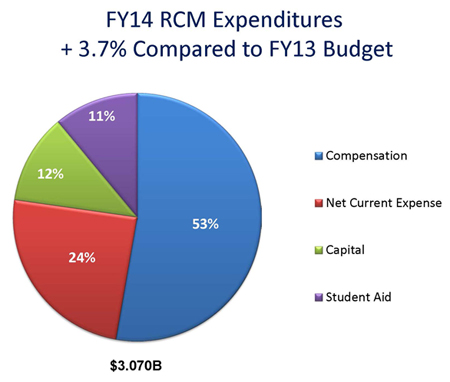
Our expenditures also total $3.07 billion, with 53% of that total in compensation, including salaries and benefits ($1.62 billion). Current expense makes up 24% of our expenditures, with Capital and Student Aid representing the final 23%. This slide (below) shows what we spend our money on, while the next, who is doing that spending.
School spending represents over $2.1 billion, or 69% of our total expenditures. The next largest component, administrative centers, including Finance, HR, Public Safety, Information Systems and other administrative units, is $367 million or 12%. The cost of our space is $165 million. However, 74% of the space costs are actually for school space: if we move those costs to the school segment, school expenditures increase to 73% of the total.
Total Undergraduate Charges
As we move on to a discussion of tuition and financial aid, I’d like to review some of the FY14 facts. Our current year total charges, including tuition, fees, room and board, are $58,812. Our audited financial statements show that tuition and fees cover 69% of the cost of a Penn education, with gifts and endowment income covering the balance. Forty-seven percent of our traditional undergraduate students receive financial aid from the University, with an average freshman grant of $39,995—you could round up to $40,000 to make it easier to remember. In constant 2005 dollars, it actually costs the average aided student 10% less to attend Penn now than it did in 2005. And of course, our aid is all grant, no loan.
Financial Aid
Our total aid budget for FY14 is $428 million, a 5.4% increase over FY13. Graduate and professional aid, including stipends, is $238 million, while undergraduate aid is $190 million.
The cost of attending Penn in constant 2005 dollars is actually $1,900 or 10% lower than it was in FY05.
The distribution of traditional undergraduate grants by size for both the freshman class and the overall aided population shows that two thirds of our aided students received grants of $35,000 or more, while one third received grants of $50,000 or more.
Over the past 10 years, Penn’s increase in total charges has been at the average for our peer group. During the period we have been consistently under the average for both public and private institutions.
For FY15, the Trustees have approved a 3.9% increase to total charges, with tuition, fees, room and board at $61,132 next year. Room and board are based on the average standard room and the freshman meal plan.
This increase in total charges generated $21.6 million in incremental revenue, with $16.3 million of that in tuition. Almost $8 million of that tuition revenue is allocated to the financial aid pool.
Since 2006, the rate of increase of total charges has been declining and this is the 6th consecutive year that it is under 4%.
At the same time, we have been steadily increasing our financial aid budget. It has grown 198% since 2002, in part due to our generous all- grant policy, but also due to higher need as a result of the recession.
Graduate and Professional Tuition and Aid
In 2013, the last completed fiscal year, we had 3,110 PhD students across nine different schools. Almost all of our PhD students are fully funded for at least three years and most for five. Full funding includes tuition, fees, health insurance and a stipend. Some schools pay a higher stipend to cover the student’s purchase of health insurance. For an SAS humanities PhD student entering in the fall of 2014, the standard five-year funding package is worth over $315,000 in constant FY14 dollars.
PhD tuition and the research masters tuition will increase at 3.9%, the same rate as undergraduate tuition. Professional tuition is set by the schools based on their specific needs and markets. This year, reported increases range from 0% to 3.9%.
The distribution of PhD student and expense by school and category shows Arts & Sciences has the largest number of PhD students and the largest expenditures: over $66 million in FY13.
|