Dr. Segal, Pediatrics
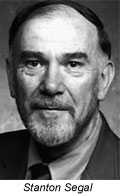
Dr. Stanton Segal, one of the world’s leading experts on inborn errors of metabolism, died April 17; he was 79. A distinguished member of Penn’s department of pediatrics for 41 years, he was widely recognized for his expertise on the genetic condition known as galactosemia, the body’s inability to break down a kind of sugar. Dr. Segal had been actively involved in the operation of his research laboratory and the publication of research articles until the time of his death.
Despite his busy schedule, Dr. Segal found time for patients and parents, as when he met recently with people in GANES, the Galactosemia Association of the North Eastern States. Last year, one of the parents involved in Parents of Galactosemic Children, Inc., described Dr. Segal in a collection of pieces as “certainly one of those shining lights for all of us who have children and young adults with Galactosemia. . . . He has the deep respect and admiration of all who knew him.”
Born and raised in Camden, New Jersey, Dr. Segal graduated summa cum laude from Princeton University in 1948. He earned his medical degree at Harvard University in 1952 and trained at HUP, New York Hospital and Cornell Medical Center. He also did training and worked as an investigator at the National Institute of Arthritis and Metabolic Diseases before joining Penn and The Children’s Hospital of Philadelphia.
During his tenure at CHOP, Dr. Segal established the division of biochemical development and molecular diseases, now known as the division of child development, rehabilitation, and metabolic disease. He introduced mass spectrometry and nuclear magnetic resonance for metabolic research, and he began a metabolic diagnostic laboratory at CHOP that is now one of the premier laboratories in the country for the study of patients with inborn errors of metabolism.
Dr. Segal’s research focused on inherited disorders of membrane transport, including cystinosis and cystinuria, and on disorders of carbohydrate metabolism, particularly galactosemia. He received many research grants to pursue his highly original and productive investigations in these areas. Several of his trainees have become world-renowned authorities in the field of metabolic diseases. Dr. Leon E. Rosenberg, a physician-scientist at Princeton University, former dean of the Yale University School of Medicine, and former president of the Pharmaceutical Research Institute of Bristol-Myers Squibb, described Dr. Segal as “the ideal mentor for me, . . . inventive about designing laboratory experiments, nurturing, and tireless.”
According to Dr. Alan Cohen, chair of Penn’s department of pediatrics, “Few physician-researchers ever had so comprehensive a knowledge of human biochemistry and its disorders.” He noted that Dr. Segal’s contributions to the current understanding of the inborn errors of metabolism earned him international recognition. In 1997, Dr. Segal was among the physicians honored in Philadelphia Magazine as “World Class Docs,” cited for his expertise in galactosemia. He received the 1998 Robert H. Herman Memorial Award, presented by the American Society for Nutrition to a clinical investigator whose research has contributed significantly to advancing clinical nutrition, particularly involving its biochemical and metabolic aspects.
In addition to his research, Dr. Segal was known as a patient advocate. He was a leader of the Committee for the Protection of Human Subjects at CHOP and served as the advocate for research subjects for Penn’s Clinical and Translational Research Center. Dr. Segal had also served on the executive committee of the University’s Faculty Senate and on the Committee on Academic Freedom and Responsibility for the Medical Faculty Senate.
Dr. Segal is survived by his wife, Joan. |