|
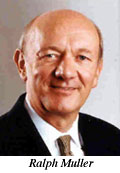
CEO of UPHS: Ralph Muller
Ralph
W. Muller has been named Chief Executive Officer of the
University of Pennsylvania Health System, effective July
1, 2003. Mr.
Muller, formerly President and Chief Executive Officer
of the University of Chicago Hospitals & Health System,
will succeed Dr. Robert D. Martin, who announced earlier
this academic year his intention to step down (Almanac October
15, 2002). Mr. Muller will begin to work with UPHS in
a transitional capacity beginning May 1.
"I am delighted that Ralph has agreed to assume this vital leadership position within Penn Medicine," said Dr. Arthur H. Rubenstein, EVP of the University of Pennsylvania for the Health System and Dean of the School of Medicine, in announcing the appointment. "Ralph's dedication to patient-centered care and effectiveness in building and leading a world-class clinical delivery organization, his leadership in national and state legislative affairs and healthcare policy organizations, and his strategic vision make him the ideal executive to lead our Health System." Mr. Muller will have management responsibility for the operational effectiveness and financial health of UPHS--a $1.7 billion provider community that includes four hospitals [HUP, Pennsylvania Hospital, University of Pennsylvania Medical Center-Presbyterian, and Phoenixville Hospital], a faculty practice plan, a primary-care provider network, three multi-specialty satellite facilities, and home healthcare, hospice and long-term care. Mr. Muller will also be responsible for further strengthening the integrated organization, and working with other healthcare, research and industry groups, as well as government leaders and business coalitions. "I look forward to contributing to one of the nation's most respected academic health systems, and eagerly anticipate the intellectual breadth and excitement that is part of a health system related to an excellent medical school and a great University," said Mr. Muller. "There's a certain vibrancy that comes from being surrounded by superb faculty, students and staff." One of Mr. Muller's top priorities will be to partner with Dr. Rubenstein in implementing the Strategic Plan for Penn Medicine. Another will be to work with his management team to further strengthen the patient-focused approach to care, and explore additional opportunities for growth that are consistent with financial realities and marketplace factors. Mr. Muller's 28-year career in healthcare administration has set the stage for his extensive knowledge of the multiple and complex challenges faced by today's urban-based academic health systems. Indeed, since the 1990s, Mr. Muller's voice has been at the forefront of the national dialogue and debate on such important health-policy issues as the social role of teaching hospitals and medical schools, federal/state payments for patient care and care of the uninsured, and the creation of patient-oriented medical care systems. Mr. Muller's career in academic medicine began in 1985 when he was named Vice President for the University of Chicago's Hospitals and Deputy Dean of Biological Sciences. (Mr. Muller's association with the Hospitals began five years earlier when he was recruited by the University of Chicago to be Director of Budget and Financial Planning.) In 1986, following the creation of a new corporate entity for the health services operations, Mr. Muller was named President and CEO of the University of Chicago Hospitals & Health System (UCHHS)--a position he held for 15 years. During Mr. Muller's leadership, UCHHS achieved significant improvements in patient-care services, as expressed in higher levels of patient satisfaction and an increase in patient revenue of more than 500 percent. The Hospitals' complex was also greatly expanded with the construction of several new facilities, including a highly successful 500,000 sq.ft. ambulatory care center (Duchossois Center for Advanced Medicine) and the soon-to-open University of Chicago Comer Children's Hospital. Mr. Muller's additional achievements included the creation of the University of Chicago Hospitals Academy, an in-house center for employee training that has become a national model for staff education; and significant contributions from the Hospitals to the University's Academic Renewal Fund to support its academic mission. On the national front, Mr. Muller was named (in May 2001) to the Medicare Payment Advisory Commission (MedPAC), an independent federal body that advises the U.S. Congress on issues affecting the Medicare program. From 1999-2000, Mr. Muller served as Chairman of the Association of American Medical Colleges (AAMC), the umbrella advocacy organization that represents the interests of the 141 accredited medical schools in the US and Canada, and the nation's 400 major teaching hospitals. In that role Mr. Muller partnered with the AAMC's leadership to advocate for increased research funding and improvements to medical education, as well as the development of a new coalition of health care providers to improve access to care for the underinsured. Mr. Muller has held a number of other leadership positions in national organizations--including Chair of the AAMC's Council of Teaching Hospitals and Health Systems, Vice-Chair of the Board of the University HealthSystem Consortium, and Chair of the Board of the National Opinion Research Center, in Chicago. In addition, he is a Fellow of the American Association for the Advancement of Science. Prior to launching his career in healthcare, Mr. Muller held executive positions in the state government of Massachusetts--including Budget Director and, later, Deputy Commissioner of the Department of Public Welfare where he was responsible for the state Medicaid program. He was a Teaching Fellow at Harvard University, where he earned his M.A. degree in government. He obtained a B.A. in economics, magna cum laude, from Syracuse University. Most recently, Mr. Muller led a comparative study of US and British health care systems for the King's Fund, a London-based healthcare foundation. Since 2002, he has served as a director of Stockamp & Associates, a national firm that specializes in helping non-profit health institutions improve their revenues and patient care programs.
|
|