HUMAN RESOURCES
Health Care and Penn
Health care has been the
recent focus of much discussion in
the media and in the political arena.
With the annual health benefits Open
Enrollment period approaching next
month (April 14-25), it is also a
timely topic here at Penn. Throughout
the months of March and April, Human
Resources will be sending out information
about health care. Some materials
will be sent to your home address,
some to your intramural address. In
addition to those materials, Almanac will
be running a multi-week series of
articles focusing on health care and
Penn. This one gives a background
on the nationwide issue of rising
health care costs and how Penn's costs
compare to other employers. Future
articles will discuss topics such
as changes that Penn will be making
to help deal with this issue and what
you can do to contain your own costs,
as well as specific information about
Penn's Open Enrollment period.
Health Care Costs Continue to Skyrocket
Rising health care costs
have been a nationwide topic of concern
over the past several years. Within
the past 5 years alone, the overall
cost of health care for large employers
(10,000 employees or more) has increased
nearly 47%, according to a study by
Hewitt Associates, a global human
resources and benefits consulting
firm. In 2002, employers absorbed
the biggest annual cost increase in
over 10 years. And experts can see
no end to these skyrocketing cost
trends in the near future.
Penn has not remained untouched
by this phenomenon. We experienced
a 13% increase in health care costs
in fiscal year 2002, over 9 times
the inflation rate of 1.4% for that
same year. Our spending for health
care totaled $65 million! Without
cost controls, that $65 million expense
is expected to double in a
mere 5 1/2 years.
Why are Health Care Costs Rising?
Many of the reasons for these
rising costs go beyond the control
of employers. For example, prescription
drug costs have been the fastest growing
expense, projected to grow at 20%
to 30% annually. New, more expensive
drugs are constantly being introduced.
Plus, pharmaceutical companies have
stepped up their direct-to-consumer
marketing, increasing the demand for
and utilization of these drugs. The
combination of these factors has caused
drug costs to rise at an alarming
pace.
Another cost driver for health
care is an issue that has gained a
lot of press lately: the number of
uninsured in America. As noted in
a recent article on Penn's Knowledge@Wharton
website, http://knowledge.wharton.upenn.edu/,
many experts agree that insuring the
uninsured is the nation's top health
care issue. More than 41 million people
across the country do not have health
insurance, a situation that contributes
to rising health care costs in many
ways. For example, those without insurance
may choose not to pay for the relatively
inexpensive preventive care that can
help prevent serious illnesses. Then
when the uninsured become seriously
ill, this costly care must be paid
for somehow·and those costs are typically
passed on to those who do have insurance,
in the form of higher premiums.
Added to these factors are
the realities that Penn's employee
population is aging, and people are
simply using more health care services
these days. These are some of the
major influences on Penn's cost increases,
as our participants tend to utilize
our plans on a higher-than-average
basis. At the same time, the costs
of these health care services are
on the rise, due to factors such as
high-priced advances in medical technology
and treatment, and exorbitant malpractice
insurance premiums. This high usage
of increasingly more expensive benefits
leads to even higher costs for the
University.
How does Penn compare?
Hewitt Associates gathered
benchmarking data from large employers
nationwide (representing over 17 million
health plan participants) to compare
Penn's health care information with
local and national averages. The local
market data was gathered from Philadelphia-area
employers (Pennsylvania, New Jersey,
and Delaware).
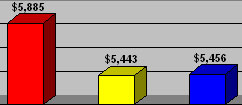
In comparison to the local
and national markets represented by
Hewitt's study, Penn's total health
care costs per employee are above
average, at over $5,800 per employee
per year. This means that we're paying
about 8% more per employee than most
other employers in the nation.
Why are our costs higher
than most employers? Total health
care costs are affected by factors
such as demographics, plan design,
and the financial efficiency of health
plans. All of these contribute to
Penn's high costs.
Demographics
Statistics show that women and older individuals tend to be the most
frequent users of health care
services. Penn employs a higher-than-average
proportion of female and older
workers, which serves to increase
the utilization of our plans
and drive up our health care
costs. According to Hewitt's
study, Penn's costs related to
the age and gender of our employees
are 8% higher than average.
Total
Health Care Costs per Employee
Plan Design Richness
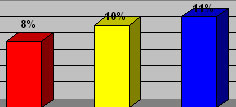
Penn's plans offer richer benefits than most employers in the local
and national markets. Employee
out-of-pocket costs for our plans
average just 8% of the total
plan costs, compared to 10% and
11% for the local and national
markets respectively.
Employee
Out-of-Pocket Costs
Financial Efficiency of Health
Plans
As part of Hewitt's study,
analysts calculate what's called the
financial efficiency of health care
plans. This measure compares the total
costs of all health plans against
each other to see how efficiently
they operate. A financial efficiency
score of 100% is the average across
all plans. Scores above 100% represent
a higher-than-average efficiency,
and scores below 100% represent a
lower-than-average efficiency. Penn's
overall score has decreased from 107%
in fiscal year 2002 to 95% in the
current fiscal year, indicating that
the financial efficiency of our health
plans has fallen to a below-average
level compared to the other companies
included in the study. The main reason
for this decrease has been the high
rate of utilization of our plans by
our employees (see Why are Health Care Costs Rising?, above).
Despite these financial challenges,
Penn still provides a competitive
benefits package to our employees.
In particular, the HMO plans offered
by Penn present the most cost-effective
option to employees, with total employee
costs well below the local and national
averages.
Total
Employee Costs-HMO

|
Total
Employer Costs-HMO
Plans

|
Look for More Information
Look for more information
in next week's Almanac as the "Health
Care and Penn" series continues. For
questions about the health benefits
offered by Penn, visit the HR website
at www.hr.upenn.edu/benefits or
call the Penn Benefits Center at 1-888-PENNBEN
(1-888-736-6236).
--Division of Human Resources
|