
DEATHS
IAN McHARG | OCTAVIO SALATI | HAROLD STASSEN
Ian McHarg, Landscape Architecture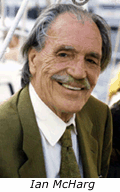
Ian L. McHarg, professor emeritus of landscape architecture and regional planning, died on March 5, at the age of 80. Born in Scotland, Professor McHarg became a U.S. citizen and earned his bachelor's and master's degrees from Harvard University. He came to Penn in 1954 and was the founder of the Landscape Architecture and Regional Planning Department. He was perhaps best known for introducing environmental concerns in landscape architecture. Professor McHarg received the Harvard Lifetime Achievement Award and 15 medals, including the National Medal of Art and the Thomas Jefferson Foundation Medal in Architecture. He was also instrumental in founding the original Earth Week and he took his environmental cause to Washington, participating in conferences and task forces in the Kennedy, Johnson, Nixon and Carter administrations. Last year, he was awarded the Japan Prize in city planning (Almanac January 11, 2000). The Japan Prize is presented annually to scientists and researchers who have made a substantial contribution to the advancement of science and technology. In 1997, Professor McHarg received the Pioneer Award from the American Institute of Certified Planners. In 1984, Connoisseur magazine named him as one of 131 "American Living Monuments." His "Man and Environment" classat Penn spanned 20 years. He has also been in the national spotlight as host of the CBS series "The House We Live In" and in his film "Multiply and Subdue the Earth."
His book, Design With Nature (1969)--widely considered one of the most important and influential works of its kind--has been one of the most widely used textbooks on landscape architecture and architecture in the U.S. His publications also include A Quest for Life, The Once and Future Forest and To Heal the Earth.
He is survived by his wife, Carol Smyser McHarg; his sons, Alistair Craig, Malcolm Lennox, Ian William and Andrew Maxwell; and two sisters. The family suggests contributions to the London Grove Friends Meeting c/o Arthur Yeatman, 432 Leaman Road, Cockranville, PA 19330.
IAN McHARG | OCTAVIO SALATI | HAROLD STASSEN
Dr. Salati, Electrical Engineering
 Dr. Octavio M. Salati,
professor emeritus of electrical engineering, died on January 27, at the
age of 86. After receiving a B.S. in electrical engineering from the Moore
School of Electrical Engineering in 1936, he was employed by the Philco
Radio and Television Company, the Radio Corporation of America, C. G. Conn
Ltd., and Hazeltine Electronics Corporation, before returning to Penn as
a research associate in 1948.
Dr. Octavio M. Salati,
professor emeritus of electrical engineering, died on January 27, at the
age of 86. After receiving a B.S. in electrical engineering from the Moore
School of Electrical Engineering in 1936, he was employed by the Philco
Radio and Television Company, the Radio Corporation of America, C. G. Conn
Ltd., and Hazeltine Electronics Corporation, before returning to Penn as
a research associate in 1948.
During his time at Hazeltine, Dr. Salati received a patent on what was to become known as the BNC connector. The connector was probably the most commonly used connector on cables carrying very high frequency currents between various pieces of equipment in the newly expanding fields of RADAR and microwave communications during and immediately after World War II. The connector is still used extensively in the electronics industry.
While at Penn, Dr. Salati divided his time between teaching and electronics research and made major contributions to the rapidly developing field of Electromagnetic Compatibility, while leading research projects supported by various branches of the Department of Defense. He received his Ph.D. from Penn in 1963 and was appointed professor of electrical engineering in 1975.
In 1972, Dr. Salati was appointed by Dean Humphrey to the position of Director of Continuing Education and Educational TV Systems. This program, which was specially funded, enabled the engineering departments to offer graduate courses to students in plants in outlying areas of the Philadelphia region, and required significant changes in teaching techniques on the part of the faculty who were involved.
In addition to the patent on the coaxial connector, Dr. Salati had four other US patents and one Canadian patent. He was made a Fellow of the IEEE in 1973. Dr. Salati retired in 1984.
Dr. Salati is survived by his wife, Marie; and two children, Lisa and Ronald.
IAN McHARG | OCTAVIO SALATI | HAROLD STASSEN
Harold Stassen, Former Penn President
 Harold Edward Stassen,
former president of Penn, died on March 5, at the age of 93. Mr. Stassen
was president of the University from 1948 to 1953.
Harold Edward Stassen,
former president of Penn, died on March 5, at the age of 93. Mr. Stassen
was president of the University from 1948 to 1953.
Mr. Stassen received a law degree from the University of Minnesota at age 21 and by age 31 was elected governor of the state. He was reelected to that office twice and gave the keynote address at the 1940 GOP Convention in Philadelphia.
He resigned his position as governor in his third term in 1943 to join the Navy, where he was a top aide to Admiral William F. Halsey. In 1945 President Roosevelt appointed Mr. Stassen to serve on an eight-member U.S. delegation that helped write the United Nations charter. He ran for the GOP nomination in 1948, losing to Thomas Dewey. He went on to pursue the GOP nomination eight more times but was never successful.
He began his service as President of Penn in 1948 after being appointed by the Trustees and was credited with raising the academic standards of the University. He resigned from that position in 1953 to supervise an assistance program of Cold War allies.
In 1958 he moved to Philadelphia where he practiced law and ran for governor in 1958 and 1966 and mayor in 1959.
He is survived by his son, Glen; his daughter, Kathleen Berger; seven grandchildren and four great grandchildren.
IAN McHARG | OCTAVIO SALATI | HAROLD STASSEN
Almanac, Vol. 47, No. 26, March 20, 2001