
DEATHS
Dr. Baker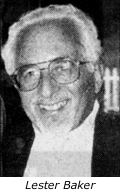
Dr. Lester Baker, professor of pediatrics at Children's Hospital of Philadelphia, died on September 17 at the age of 70. Dr. Baker was the director of Penn's Diabetes Research Center from 1993 until his death.
He received his B.A. from Columbia College, an M.A. Equivalent Certificate from the University of Paris School of Law and Higher Studies, and an M.D. from Columbia University. He came to Penn as an assistant professor of pediatrics in 1966, became associate professor in 1970 and was promoted to professor in 1976. He has authored or co-authored over 100 original articles as well as numerous abstracts, chapters and the book Anorexia Nervosa in Context (Harvard 1978).
Dr. Baker was a principal investigator for a 10-year study, the Diabetes Control and Complications Trial (DCCT). He helped design and implement a landmark national study in the 1980s and 1990s that showed that rigorous control of blood-sugar levels can dramatically cut down the disease's serious complications. In 1994 he received an award as outstanding clinician in diabetes from the American Diabetes Association.
He is survived by his wife Liesel; a son Herbert Phillip; a daughter Deborah Ann White; and two grandchildren. Contributions may be made to the Diabetes Research Center at the Children's Hospital of Philadelphia, One Children's Center, 34th and Civic Center Boulevard, Philadelphia, PA 19104.
Dr. Pollack
Dr. Howard Pollack, emeritus professor of radiology and urology, died on September 20 at the age of 72. Dr. Pollack was a pioneer in using lithotripsy to crush kidney stones and helped develop the use of imaging techniques such as ultrasound to diagnose and treat diseases of the urinary and reproductive systems.
A graduate of West Philadelphia High School, Dr. Pollack received both his undergraduate and medical degrees from Temple University. He joined Penn in 1977 as professor of radiology and urology, retiring in 1993.
He wrote more than 200 scientific papers and wrote the textbook Clinical Urography, considered the definitive textbook for the specialty. He developed techniques for using ultrasound-guided needles to take biopsies, as well as nonsurgical treatment for opening blockages in the urinary tract and female reproductive system. Dr. Pollack and Dr. Barry Goldberg, of Thomas Jefferson University, established a classification system for using ultrasound to determine benign or potentially cancerous kidney lesions. Dr. Pollack served on editorial boards of more than a dozen medical journals and helped found the Society of Uroradiology.
He is survived by his wife Shanlee; three sons Mathew, Andrew and Stuart; three grandchildren; and a sister.
Contributions may be made to the Philadelphia Jewish Sports Hall of Fame, Jewish Community Centers of Greater Philadelphia, 401 S. Broad St., Philadelphia, PA 19147; or the Hospice at Abington Memorial Hospital, 2510 Maryland Rd., Willow Grove, PA 19090.
Almanac, Vol. 47, No. 5, September 26, 2000
| FRONT PAGE | CONTENTS | JOB-OPS | CRIMESTATS | BENCHMARKS: Electronic Privacy in Practice | 1999-2000 COUNCIL REPORTS: Admissions & Financial Aid, Pluralism, Communications, Community Relations, Personnel Benefits and Quality of Student Life | TALK ABOUT TEACHING ARCHIVE | BETWEEN ISSUES | OCTOBER at PENN |