
 |
|
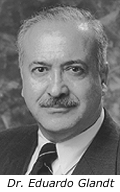 SEAS Dean: Dr. Glandt
Dr. Eduardo D. Glandt, a distinguished member of the School of Engineering and Applied Science for more than two decades, has been named Dean of the School, President Judith Rodin said Friday. His appointment will become effective on confirmation by the Trustees in January.
Dr. Glandt has served as interim dean since August 1998, in what Dr. Rodin has termed an "exemplary period" of attracting new resources, making significant faculty appointments and supporting interdisciplinary teaching and research. "It is a tribute to the great strength of our faculty when a thoughtful, carefully-conducted and exhaustive search that identified many wonderful candidates leads ultimately to a distinguished scholar in our own midst," Dr. Rodin said. "We couldn't be more delighted at the result because we believe Eduardo Glandt is the best possible person to lead the School into the next century."
Dr. Glandt received his bachelor's degree magna cum laude from the University of Buenos Aires in 1968 and joined the National Institute of Industrial Technology in Buenos Aires, where from 1967-73 he was responsible for technical consulting services to the mineral industry and for pilot plant-level process development.
Taking a year out in 1969-70, he came to the U.S. as a visiting researcher for the Bureau of Mines and a United Nations Fellow. Later he returned to take his advanced degrees in chemical engineering from Penn--a master's in 1975 and Ph.D. in 1977.
Joining the faculty in 1975, he became an associate professor in 1981, professor in 1985, and Carl V.S. Patterson Professor in 1990. Five years later he was named to the Russell P. and Elizabeth C. Heuer Professorship, which he held until 1998. He was the Gulf Visiting Professor at Carnegie-Mellon in 1989-90, and chair of chemical engineering in 1991-94.
Dr. Glandt's research has focused on classical and statistical thermodynamics, theories of liquids and of liquid mixtures, adsorption, interfacial phenomena, membrane partitioning, colloids and heterogeneous media. A prolific author and presenter (of more than 250 seminars), he has delivered named lectures at universities throughout the U.S., including those at Princeton, CalTech, Texas, Rutgers, Rensselaer and Yale.
Elected to the National Academy of Engineering in 1996, Dr. Glandt is also a member of the American Association for the Advancement of Science and other prestigious organizations.
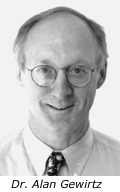 Dr. Gewirtz and the $3 Million Doris Duke Award
Dr. Alan M. Ge-wirtz, professor of medicine and pathology at Penn Med and leader of the Stem Cell Biology and Therapeutics Program in the Cancer Center, is one of four recipients of the first Doris Duke Distinguished Clinical Scientist Awards for Excellence in Bench to Bedside Research for Research on Sickle Cell Disease and Other Blood Disorders.
Dr. Gewirtz will receive $3 million over the next five years to use in his work on Nucleic Acid Therapeutics for Human Leukemia, which sets out to develop more effective, less toxic therapies for human leukemia--and that can, researchers hope, be applicable to a larger spectrum of blood disorders and perhaps to cancer and cardiovascular diseases as well. The work focuses on the use of short strands of nucleic acids (oligonucleotides) to disrupt gene expression in diseased cells.
Dr. Gewirtz, a member of the PennMed faculty since 1990, has devoted his career to studies of normal and malignant human hematopoiesis and ways of translation basic scientific discoveries into clinically useful therapies for patients with disorders of blood formation.
Doris Duke, who died in 1993, left her fortune to the Doris Duke Charitable Foundation, which supports a variety of interests, including environmental and ecological causes, medical research, and the performing arts. The Bench to Bedside awards support "physician-scientists who lead outstanding clinical research programs that apply the latest biomedical research advances to the prevention, treatments and cure of disease." They are given in four disease areas: cancer, AIDS, cardiovascular diseases, and sickle cell anemia and other blood disorders.
Renewing Hamilton Village
|
At left and on in a story here, the conceptual design submitted by Patkau Architects, from Vancouver, Canada. They have been asked to do a feasibility study for the north-western quadrant of Hamilton Village. |
| At right, the conceptual design submitted by Kieran, Timberlake & Harris, a Philadelphia-based architectural firm which has been named to do a feasibility study for the high-rises, starting with Hamilton College House. |  |

Almanac, Vol. 46, No. 11, November 9, 1999
| FRONT PAGE | CONTENTS | JOB-OPS | CRIMESTATS | COUNCIL: On Financial Aid | COUNCIL MEMBERSHIP & COMMITTEES | TALK ABOUT TEACHING ARCHIVE | BETWEEN ISSUES | NOVEMBER at PENN |