
Four Chairs in Psychiatry
At a reception in September, the Department of Psychiatry honored four new holders of endowed chairs and the donor of two of those chairs, Dr. Karl Rickels (see front page). The honorees, and some notes on their contributions to the field:
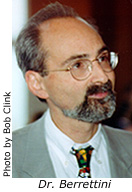 |
Karl E. Rickels Professor: Dr. BerrettiniDr. Wade Berrettini, who joined PennMed in 1997 as professor and director of the Center for Neurobiology and Behavior, is the first Karl E. Rickels Professor of Psychiatry, in the chair established by Dr. Karl Rickels in honor of his father (see front page). Dr. Berrettini is an alumnus of Dickinson College with an M.D. and Ph.D. in pharmacology from Thomas Jefferson University. His scientific achievements include mapping a gene for susceptibility to manic-depressive illness (bipolar disorder) to the short arm of chromosome 18 and delineating the role of the mu opioid receptor gene in genetic susceptibility to heroin dependence. In addition to genetic studies of bipolar disorder, he investigates genetic susceptibility to anorexia nervosa, alcoholism and epilepsy. In 1996, Dr. Berrettini received the Selo Prize from the National Alliance for Research in Schizophrenia and Depression (NARSAD) for outstanding achievement in the study of depression. |
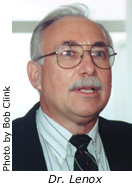 |
Karl and Linda Rickels Professor: Dr. LenoxThe first to hold the new chair named for Professor Rickels and his wife is Dr. Robert H. Lenox, vice chair of research development, who has been professor of psychiatry, pharmacology and neuroscience and director of the Molecular Neuropsychopharmacology Program since 1998. He is an MIT alumnus who took his M.D. from Vermont, and is internationally known for providing insights into the biological basis of the treatment and underlying pathophysiology of manic depressive illness. A recipient of the NARSAD Distinguished Investigator Award and the Ziskind-Somerfeld Basic Science Award from the Society of Biological Psychiatry, he is on the scientific advisory boards for the NIH and the National Alliance for Research in Schizophrenia and Depressive Disorders and the National Depressive and Manic Depression Association. He was recently named Editor-in-Chief of Neuropsychopharmacology, the journal of the American College of Neuropsychopharmacology. |
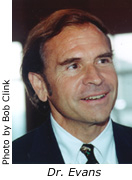 |
Ruth Meltzer Professor: Dr. EvansAs chair of the psychiatry department, Dr. Dwight L. Evans takes an endowed chair created in 1992 by the philanthropist Ruth Meltzer to foster the relationship between psychiatry and law and promote the healthy growth and development of children. Dr. Evans is internationally known for his research on the impact of stress and depression on other diseases including cancer, AIDS and cardiac cases, and the molecular mechanisms that may underlie such relationships between the brain and the body. A graduate of Elizabethtown College, he took his M.D. at Temple and was a Robert Wood Johnson Scholar at North Carolina before joining Penn in 1997. A fellow of the American College of Psychiatry and the American College of Neuropsychopharmacology, he is a senior examiner for the American Board of Psychiatry and Neurology and was recently named to the board of the American Foundation for Suicide Prevention. In 1997, he received one of the highest honors in the field, the Klerman Lifetime Research Award of the National Depressive and Manic-Depressive Assocaition. |
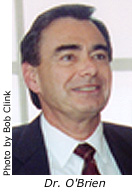 |
Kenneth C. Appel Professor: Dr. O'BrienDr. Charles P. O'Brien, professor and vice chair of psychiatry, has been named to the chair established in 1965 to honor Dr. Appel, the longime PennMed faculty member and department chair (1952-62) who was instrumental in establishing the U.S. Joint Commission on Mental Health and Mental Illness, and in bringing the Marriage Council of Philadelphia into the department. Dr. O'Brien, a Tulane alumnus who also took his M.D. and Ph.D. there, has been at Penn since completing his residency here in 1969 and is chief of psychiatry at the Philadelphia Veterans Affairs Medical Center as well as director of the University's Center for Studies of Addiction. Working in the psychopharmacology of addiction--and the development of new behavioral and pharmacological treatments for addiction, including alcoholism, through using controlled clinical trials--he and his team have been responsible for numerous discoveries that have improved the results of treatment for addictive disorders. A member of the Institute of Medicine of the National Academy of Sciences, he also holds an honorary doctorate from Bordeaux, and was recently elected President of the American College of Neuropsychopharmacology. |
Almanac, Vol. 46, No. 6, October 5, 1999