
College Houses: New Appointees in Profile
Last week Interim Provost Michael Wachter announced five more appointments to posts in the College Houses--three new faculty masters another Faculty Fellow, and the selection of a Director of College Houses and Academic Services.
"These appointments, along with our other College House Faculty Masters and Fellows, reflect a depth of talented Penn faculty in residence that is truly impressive." said Dr. Wachter. "I'd like to thank the many students, faculty and staff who generously contributed their time, energy and input to ensuring that our college houses will be led by the very best that Penn has to offer." Faculty Masters are appointed by the Provost to three-year terms, renewable for a similar term or terms thereafter. Faculty Fellows are selected by Faculty Masters in consultation with students and staff within each College House and serve two-year terms.
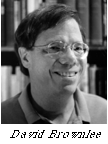 Director of College Houses and Academic Services:
Dr. Brownlee
Director of College Houses and Academic Services:
Dr. Brownlee
Dr. David Brownlee, professor of art history in SAS and Faculty Master of Harnwell College House (Almanac March 24), has been the interim director of College House Implementation and was recently elected chair of the Residential Faculty Council (RFC). He has been integrally involved in the creation of the comprehensive College House system as chair of planning and working committees that led to its formation.
He will report directly to the Provost and indirectly to the Vice Provost for University Life (VPUL) and the Council of Undergraduate Deans (CUD). As Director, Professor Brownlee will have full administrative responsibility for the Department of Academic Programs and Residence Life (APRL) and other related academic service functions, including the "Wheel," that reinforce the academic mission of the College Houses and provide them, in their diversity, with strong central support.
"Penn is at an important point in its history," Dr. Brownlee said, "And this is a once-in-a-lifetime opportunity for me to give something back to the institution that has supported me throughout my career as a scholar and teacher. We have firmly attached the College Houses to Penn's intellectual goals, we have appointed resident faculty and staff inunprecedented numbers, and we have forged an extraordinary new partnership among the College Houses and all four of the undergraduate schools. By doing those things we have also established a new paradigm for undergraduate education at Penn. "I have worked for a long time with many wonderfully talented people to help create the College House system, and it will be tremendously rewarding to see the project come to life in the months ahead."
Three Faculty Masters
The three new Faculty Masters are Dr. Robert Lucid of English, who is returning to the residential system after conducting off-campus research; Philip Nichols of legal studies at Wharton School; and Dr. Kenwyn Smith, who teaches organizational behavior at the School of Social Work, at Wharton's Aresty Institute, and in the Fels Center of Government.
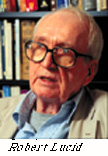 Gregory: Dr. Lucid.
Dr. Lucid will be joined by his wife Joanne in Gregory College House, which
comprises the Van Pelt and Modern Languages houses. Professor Lucid has
a long, distinguished history with Penn's College Houses, having served
as Faculty Master of Hill College House from 1979 to 1996. From 1994 to
1996, Dr. Lucid was the chair of the Residential Faculty Council (RFC).
He was also the Chairman of the Collegiate Planning Board, the planning
board from which the idea for a comprehensive College House system at Penn
originated.
Gregory: Dr. Lucid.
Dr. Lucid will be joined by his wife Joanne in Gregory College House, which
comprises the Van Pelt and Modern Languages houses. Professor Lucid has
a long, distinguished history with Penn's College Houses, having served
as Faculty Master of Hill College House from 1979 to 1996. From 1994 to
1996, Dr. Lucid was the chair of the Residential Faculty Council (RFC).
He was also the Chairman of the Collegiate Planning Board, the planning
board from which the idea for a comprehensive College House system at Penn
originated.
A 1954 alumnus of the University of Washington, Dr. Lucid took his A.M. and his Ph.D. in English from Chicago (1958) and taught at Chicago and at Wesleyan before joining Penn in 1964 as an assistant professor of English. Promoted to associate professor four years later, he became full professor in 1975.
Long known among scholars for such work as The Journals of Richard Henry Dana, Jr., 3 vols. (Belknap/Harvard), he became a household name with Norman Mailer, the Man and his Work (Little, Brown). He is currently at work on Mailer's authorized biography. His numerous honors include a Yaddo Fellowship, the Lindback Award, and the Ira Abrams Award for Distinguished Teaching given by SAS.
Dr. Lucid served as graduate chairman of the English department in 1974-76, and chair of the department in 1980-85. He also founded the Penn-in-London program.
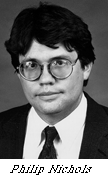 Stouffer: Mr. Nichols.
The new Faculty Master of Stouffer College House is Professor Philip Nichols,
an assistant professor of legal studies at Wharton who has been a Faculty
Fellow at Stouffer for the past two years. With him are his wife, Amy S.
Nichols, and their three sons, Tanner, 5; Hilyard, 3; and Browning, 2.
Stouffer: Mr. Nichols.
The new Faculty Master of Stouffer College House is Professor Philip Nichols,
an assistant professor of legal studies at Wharton who has been a Faculty
Fellow at Stouffer for the past two years. With him are his wife, Amy S.
Nichols, and their three sons, Tanner, 5; Hilyard, 3; and Browning, 2.
Professor Nichols took his A. B. in anthropology at Harvard in 1982 and his J.D. and LL.M. in foreign and international law from Duke in 1988. He joined the Wharton faculty in 1992 and was the Ronald Koenig Term Assistant Professor from 1994 to 1997.
For his teaching in international business, the legal aspects of doing business with emerging economies, and other courses in law and business, he has won numerous teaching awards including the 1996 David W. Hauck Award for Outstanding Undergraduate Teaching; the 1996 Intergreek Council Award for Outstanding Professor and Wharton's Undergraduate Teaching Award every year for the past five years.
He is the faculty advisor for Phi Alpha Delta, (Penn's pre-law society); Alpha Kappa Psi (the undergraduate business society); and the University's new mock trial team.
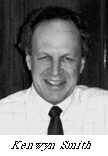
Ware: Dr. Smith. Joining Dr. Kenwyn Smith in Ware College House will be his wife, Dr. Sara Corse, and their three children, 10-year-olds Justin and Phillip, and 7-year-old Kalila. Dr. Corse is a clinical psychologist who is a research consultant and clinical assistant professor of psychology in psychiatry at PennMed.
Before arriving at Penn as associate professor of organizational behavior at Wharton Shool in 1983, Dr. Smith taught at the University of Maryland (1977-1983), the University of Melbourne (1975-77 and 1970-71) and the University of New Haven (1974).
An alumnus of the University of Queensland, where he took his B.A. (Honours) in 1967 and M.A. in 1970, Dr. Smith also holds an M.A. from Yale (1973) where he took his Ph.D. in organizational behavior in 1974.
He has won numerous teaching awards at Penn, including the Excellence in Teaching Award from Wharton MBA (1989 and 1990); the Anvil Award, Wharton, MBA (1990) and the Excellence in Teaching Award, SSW, MSW, 1994. His research focuses on organizational change, group dynamics and the management of conflict. He is particularly interested in the impact of organizational dynamics on the physical and emotional health of employees.
He has also been deeply committed to working with people living with AIDS. He is a co-founder of MANNA (Metropolitan AIDS Neighborhood Nutritional Alliance), which delivers meals free six days a week to homebound people living with AIDS in the Philadelphia area. Dr. Smith served as chair of MANNA's Board of Directors from 1990 to 1996. MANNA's first ten meals were donated by the Faculty Club at Penn and delivered by Penn employees.
A Faculty Fellow 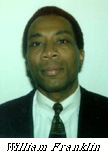
Du Bois: Dr. Franklin. Dr. William Franklin, who joins the University this year as a post-doctoral research specialist for GSE's Center for Health Achievement, Neighborhood Growth and Ethnic Studies (CHANGES), will also become a Faculty Fellow at Du Bois College House, where Dr. Howard C. Stevenson Jr. is Faculty Master.
Dr. Franklin, who specializes in child and adolescent development, took his B.A. in 1987 and M.A. in 1990 from California State University, winning the Outstanding Graduate Student Award at the Northridge campus. He earned his Ph.D. in psychological studies from Stanford in 1995. He has been an associate professor at California State/Monterey Bay, in the Center for Collaborative Education and Professional Studies where he has taught courses including child and adolescent development and the African-American child. He has also been the associate director of the Back on Track Research and Training Center there, focusing on building partnerships in underserved communities and assisting families and youth placed at risk.
During the past three years, he served also as co-director of a Teacher Recruitment/Diversity Project, as faculty advisor to the African-American Students' Union, chair of the Academic Advising Task Force, chair of the First Annual African-American/Latino Youth Summit, and a member of the Student Affairs Committee.
A recipient of a Spencer Dissertation Fellowship and and other awards,
Dr. Franklin was a resident fellow at California State/Northridge from 1988-90,
where he managed the day-to-day operations of a complex housing 760 undergraduates.
Earlier he was a resident fellow with the Summer Bridge Program at California
State where he managed the overall operations of a residence hall housing
200 freshmen.
Almanac, Vol. 44, No. 34, May 19/26, 1998
FRONT PAGE | CONTENTS | JOB-OPS | CRIMESTATS | BETWEEN ISSUES | SUMMER at PENN | PULLOUT: Commencement 1998 |