
Pullout: Report of the Provost's Committee on Distributed Learning
The School of Medicine' s 1997-98 Teaching Awards
Full-time University of Pennsylvania School of Medicine faculty members in the tenure and clinician-educator tracks are eligible for the awards described below. Nominations for teaching awards are solicited annually from faculty, housestaff and students. The dossiers of all nominees are reviewed by the Faculty Teaching Awards Committee which determines the recipient(s) for each award.
 The Leonard Berwick Memorial Teaching
Award: Established in 1980-81 as a memorial to Leonard Berwick
by his family and the Department of Pathology, the Leonard Berwick Memorial
Teaching Award recognizes a member of the medical faculty who in his or
her teaching most effectively fuses basic science and clinical medicine.
The recipient of the Berwick Memorial Teaching Award for 1997-98 is Scott
Manaker, M.D., Ph.D., Assistant Professor of Medicine in Pulmonary
Care. Dr. John Hansen-Flaschen, Chief of the Division of Pulmonary and Critical
Care Medicine describes Dr. Manaker as "one of the most active and
effective teachers in the Medical Intensive Care Unit at HUP. He has been
exceptionally successful in teaching the physiological basis for modern
management of respiratory failure and circulatory shock. His enthusiasm
for clinical problem-solving has been instrumental in attracting residents
into our fellowship training program." Students praise Dr. Manaker
as a faculty member who "treats them as colleagues rather than just
students" and who "is full of good humor and [is] a pleasure to
work with." Dr. Manaker's ability to integrate concepts in basic science
and clinical medicine fosters a deeper level of understanding of disease
processes and management issues in students and residents. He is truly a
talented teacher who e
The Leonard Berwick Memorial Teaching
Award: Established in 1980-81 as a memorial to Leonard Berwick
by his family and the Department of Pathology, the Leonard Berwick Memorial
Teaching Award recognizes a member of the medical faculty who in his or
her teaching most effectively fuses basic science and clinical medicine.
The recipient of the Berwick Memorial Teaching Award for 1997-98 is Scott
Manaker, M.D., Ph.D., Assistant Professor of Medicine in Pulmonary
Care. Dr. John Hansen-Flaschen, Chief of the Division of Pulmonary and Critical
Care Medicine describes Dr. Manaker as "one of the most active and
effective teachers in the Medical Intensive Care Unit at HUP. He has been
exceptionally successful in teaching the physiological basis for modern
management of respiratory failure and circulatory shock. His enthusiasm
for clinical problem-solving has been instrumental in attracting residents
into our fellowship training program." Students praise Dr. Manaker
as a faculty member who "treats them as colleagues rather than just
students" and who "is full of good humor and [is] a pleasure to
work with." Dr. Manaker's ability to integrate concepts in basic science
and clinical medicine fosters a deeper level of understanding of disease
processes and management issues in students and residents. He is truly a
talented teacher who e xemplifies the commitment to the highest
standards of medical education at Penn.
xemplifies the commitment to the highest
standards of medical education at Penn.
The Blockley-Osler Award: Created in 1987 by the Blockley Section of the Philadelphia College of Physicians, this award is presented annually to a member of the faculty at an affiliated hospital for excellence in teaching modern clinical medicine in the bedside tradition of Dr. William Osler. The 1997-98 Blockley-Osler Award is given to Paul M. Weinberg, M.D., Associate Professor of Pediatrics and Radiology at The Children's Hospital of Philadelphia. Under Dr. Weinberg's leadership, one of the highest caliber training programs in pediatric cardiology in the country has been developed at CHOP. Dr. Victoria Vetter, a colleague of Dr. Weinberg in the Department of Pediatrics, commends his commitment to medical education, saying, "Paul provides direction and leadership to the educational program; his enthusiasm and structured didactic methods captivate his audience immediately." Students echo Dr. Vetter's praise, commenting that "His enthusiasm is contagious." A former fellow emphasizes Dr. Weinberg's talent as "a mentor" and "a source for numerous research topics." Dr. Weinberg is clearly an esteemed teacher and colleague, valued by fellow faculty members, post-graduate trainees and students for his proactive commitment to excellence in medical education at all levels.
 The Robert Dunning Dripps Award
for Excellence in Graduate Medical Education: Established in
1983 by the Department of Anesthesia, the Robert Dunning Dripps Award recognizes
a faculty member who exemplifies excellence in the education of residents
and fellows in the areas of clinical care, research, teaching and/or administration.
The 1997-98 Dripps Memorial Award for Excellence in Graduate Medical Education
is presented to Alan Cohen, M.D., Professor of Pediatrics and Chief
of the Division of Hematology at The Children's Hospital of Philadelphia.
Since joining the faculty in 1978, Dr. Cohen has distinguished himself as
an outstanding teacher who serves as a role model for residents and fellows
as an educator, a teacher and an administrator. Dr. Cohen's adeptness in
linking academic and research aspects of hematology with fundamental pediatric
practice methods imparts both essential and complex aspects of pediatric
hematology. His teaching methodology inspires trainees to think critically
and to make decisions carefully, essential attributes which a consummate
clinician like Dr. Cohen exemplify. Colleagues revere him as "a teacher
whose standard of excellence causes his students and those he mentors to
develop high standards of their own." Residents describe Dr. Cohen
as "a role model with an infectious enthusiasm for hematology. Dr.
Cohen possesses an impressive breadth of knowledge which he is excited to
share." Dr. Alan Cohen's enthusiasm for the field of hematology and
for teaching as well as his high standards of clinical practice make him
a superb role model for future pediatric hematologists and physicians in
other specialties alike.
The Robert Dunning Dripps Award
for Excellence in Graduate Medical Education: Established in
1983 by the Department of Anesthesia, the Robert Dunning Dripps Award recognizes
a faculty member who exemplifies excellence in the education of residents
and fellows in the areas of clinical care, research, teaching and/or administration.
The 1997-98 Dripps Memorial Award for Excellence in Graduate Medical Education
is presented to Alan Cohen, M.D., Professor of Pediatrics and Chief
of the Division of Hematology at The Children's Hospital of Philadelphia.
Since joining the faculty in 1978, Dr. Cohen has distinguished himself as
an outstanding teacher who serves as a role model for residents and fellows
as an educator, a teacher and an administrator. Dr. Cohen's adeptness in
linking academic and research aspects of hematology with fundamental pediatric
practice methods imparts both essential and complex aspects of pediatric
hematology. His teaching methodology inspires trainees to think critically
and to make decisions carefully, essential attributes which a consummate
clinician like Dr. Cohen exemplify. Colleagues revere him as "a teacher
whose standard of excellence causes his students and those he mentors to
develop high standards of their own." Residents describe Dr. Cohen
as "a role model with an infectious enthusiasm for hematology. Dr.
Cohen possesses an impressive breadth of knowledge which he is excited to
share." Dr. Alan Cohen's enthusiasm for the field of hematology and
for teaching as well as his high standards of clinical practice make him
a superb role model for future pediatric hematologists and physicians in
other specialties alike.
The Dean's Awards for Excellence in . . .
 . . . Clinical Teaching
at an Affiliated Hospital: This award was established in 1987
to honor commitment to medical education and excellence in clinical teaching
by recognizing outstanding faculty members from affiliated hospitals. The
1997-98 Dean's Award for Excellence in Clinical Teaching at an Affiliated
Hospital recognizes Henry R. Bleier, M.D., M.B.A., Clinical Professor
of Psychiatry at the Veterans Administration Medical Center. Chief of Consultation-Liaison
Psychiatry, Dr. Bleier has been a member of the faculty since completing
his residency at HUP in 1977. He is a consummate clinical educator, making
teaching a primary focus of his professional life. "In his various
roles as an inpatient attending, resident director and medical/psychiatry
chief, he consistently brings a truly original mind to the venerable art
of bedside clinical teaching," states Dr. Anthony Rostain, Director
of Medical Student Education for the Department of Psychiatry. One student
describes Dr. Bleier as "quite unique among the clinical teachers I've
encountered; he manages to focus complete attention on the individual patient
and, at the same time, expands the discussion to encompass the larger medical
and social issues...His incisive questions challenge the student to go beyond
what he/she has thought before." Echoing this accolade, a resident
regards Dr. Bleier's "unique approach [as] an indispensable part of
my training. His 'leave no stone unturned' philosophy of care provides the
gold-standard for consultation-liaison psychiatry." Dr. Henry Bleier
is highly esteemed as an educator and as an inspiring physician by his peers,
resident trainees and students.
. . . Clinical Teaching
at an Affiliated Hospital: This award was established in 1987
to honor commitment to medical education and excellence in clinical teaching
by recognizing outstanding faculty members from affiliated hospitals. The
1997-98 Dean's Award for Excellence in Clinical Teaching at an Affiliated
Hospital recognizes Henry R. Bleier, M.D., M.B.A., Clinical Professor
of Psychiatry at the Veterans Administration Medical Center. Chief of Consultation-Liaison
Psychiatry, Dr. Bleier has been a member of the faculty since completing
his residency at HUP in 1977. He is a consummate clinical educator, making
teaching a primary focus of his professional life. "In his various
roles as an inpatient attending, resident director and medical/psychiatry
chief, he consistently brings a truly original mind to the venerable art
of bedside clinical teaching," states Dr. Anthony Rostain, Director
of Medical Student Education for the Department of Psychiatry. One student
describes Dr. Bleier as "quite unique among the clinical teachers I've
encountered; he manages to focus complete attention on the individual patient
and, at the same time, expands the discussion to encompass the larger medical
and social issues...His incisive questions challenge the student to go beyond
what he/she has thought before." Echoing this accolade, a resident
regards Dr. Bleier's "unique approach [as] an indispensable part of
my training. His 'leave no stone unturned' philosophy of care provides the
gold-standard for consultation-liaison psychiatry." Dr. Henry Bleier
is highly esteemed as an educator and as an inspiring physician by his peers,
resident trainees and students.
. . . Basic Science Teaching: Established in 1987, this award honors exemplary teaching and commitment to medical education specifically in the basic sciences. David Goldhamer, Ph.D., Assistant Professor of Cell and Developmental Biology, is the recipient of the 1997-98 Dean's Award for Excellence in Basic Science Teaching. In the five years since joining the faculty at Penn, Dr. Goldhamer has demonstrated a strong commitment to quality medical education through his significant contributions to the teaching of the courses in embryology and histology. A first-rate scholar, Dr. Goldhamer exhibits an extraordinary talent for conveying complex concepts in a way that is easily understandable. One student praises Dr. Goldhamer's teaching in the histology course commenting, "Dr. Goldhamer is fantastic. He's knowledgeable, cares about our learning, and does a good job of mixing in humor." A second student describes Dr. Goldhamer as "one of the best lecturers I have ever had" and as "exuding a warmth and love of his subject." Dr. David Goldhamer's unfailing commitment to upholding the highest standards in medical education is admired and deeply appreciated by student and colleagues alike.
 . . . Graduate Student
Training: Established in academic year 1992-93, this award recognizes
excellence in graduate education. The 1997-98 Dean's Award for Excellence
in Graduate Student Training honors Judith Meinkoth, Ph.D., Assistant
Professor of Pharmacology. Dr. Meinkoth's exquisite knowledge base and eclectic
teaching methodologies not only benefit students in terms of concept understanding,
but also provides them with interesting and memorable learning experiences.
Since arriving at Penn in 1994, Dr. Meinkoth has been one of the most sought
after faculty mentors for students of the biomedical sciences. Additionally,
she is active in several academic committees and, on a national level, in
a number of professional societies. Dr. Meinkoth is regarded by students
and colleagues alike as "an outstanding teacher, role model and mentor."
. . . Graduate Student
Training: Established in academic year 1992-93, this award recognizes
excellence in graduate education. The 1997-98 Dean's Award for Excellence
in Graduate Student Training honors Judith Meinkoth, Ph.D., Assistant
Professor of Pharmacology. Dr. Meinkoth's exquisite knowledge base and eclectic
teaching methodologies not only benefit students in terms of concept understanding,
but also provides them with interesting and memorable learning experiences.
Since arriving at Penn in 1994, Dr. Meinkoth has been one of the most sought
after faculty mentors for students of the biomedical sciences. Additionally,
she is active in several academic committees and, on a national level, in
a number of professional societies. Dr. Meinkoth is regarded by students
and colleagues alike as "an outstanding teacher, role model and mentor."
. . . Medical Student Teaching by an Allied Health Professional: Created during the 1996-97 academic year, this award honors outstanding teaching by allied health professionals, for example, nurse, physician assistants and administrators. The 1997-98 Dean's Award for Excellence in Medical Student Teaching by an Allied Health Professional is presented to Herbert Mosher, Director of the Development Office at Rehoboth McKinley Christian Hospital and head of the Western Health Foundation in Gallup, New Mexico. Through the coordination of elective experiences in rural primary care, Mr. Mosher has significantly enriched the primary care curriculum for medical students and residents at Penn. Prior to assuming the position as Director of Development at Rehoboth McKinley, Mr. Mosher worked as an aide to Dr. Menninger of the Menninger Clinic and in the administration of Senator Robert Dole. His move to Rehoboth McKinley was precipitated by a meeting with Mother Theresa who suggested that he relocate to Gallup as, in her words, "they need you here." Under Mr. Mosher's leadership, the local health system has attracted private and government funding and has expanded the scope of its rural health programs, including the development of innovative programs for the prevention and treatment of alcoholism and the initiation of a branch of the "Reach Out and Read", a literacy enhancement program for young children and their families. A student highlights the significance of Mr. Mosher's contribution to his/her medical education saying, "his knowledge of Navajo culture and dedication to teaching health care management and primary care in rural settings made us think about which direction medicine should go." Dr. William Schwartz, Professor of Pediatrics and Penn's liaison with the Gallup program, best sums up Mr. Mosher's commitment and contributions to medical education: "Herb has set an example for all faculty in the Penn system to assure a stimulating learning environment for teaching culture, diversity and life."
Special Dean's Awards: The Special Dean's Awards, established during the 1989-90 academic year, honor special achievements by Penn faculty members, particularly in the development of new and innovative educational programs. The Vice Dean for Education, in consultation with the Teaching Awards Selection Committee, identifies faculty members who have made unique contributions to medical education at Penn during the previous year. Three distinguished faculty members are being recognized with Special Dean's Awards for the academic year 1997-98.
 Jack Ende, M.D., Professor of Medicine
and Chief of Medicine at Presbyterian Medical Center, is being honored by
the Special Dean's Award in recognition of his many contributions to educating
medical students and residents in general internal medicine and his commitment
to excellence in emphasizing bedside diagnosis skills and patient-centered
care. Dr. Ende's involvement in medical education began with his first faculty
appointment at the Boston University School of Medicine where he first served
as Director of Medical Student Education and then as Residency Training
Program Director for the Department of Internal Medicine. Dr. Ende joined
the faculty of the University of Pennsylvania in 1989 as an Associate Professor
of Medicine and Director of Ambulatory Care Education for the Department
of Medicine. In 1995, he was promoted to Associate Dean for Network and
Primary Care Education and in this capacity developed systems for training
medical students and residents in the outpatient sites within the University
of Pennsylvania Health System network of physician practices. Dr. Ende was
appointed Chief of Medicine at the Presbyterian Medical Center in 1997.
Dr. Ende has also been very active in medical education efforts at the national
level, including serving as President of the Association of Program Directors
in Internal Medicine from 1994 through 1995. The 1997-98 Special Dean's
Award appropriately recognizes Dr. Ende's significant contributions to continuous
improvement of medical education at Penn, particularly in the training of
students and residents in general internal medicine and ambulatory care.
Jack Ende, M.D., Professor of Medicine
and Chief of Medicine at Presbyterian Medical Center, is being honored by
the Special Dean's Award in recognition of his many contributions to educating
medical students and residents in general internal medicine and his commitment
to excellence in emphasizing bedside diagnosis skills and patient-centered
care. Dr. Ende's involvement in medical education began with his first faculty
appointment at the Boston University School of Medicine where he first served
as Director of Medical Student Education and then as Residency Training
Program Director for the Department of Internal Medicine. Dr. Ende joined
the faculty of the University of Pennsylvania in 1989 as an Associate Professor
of Medicine and Director of Ambulatory Care Education for the Department
of Medicine. In 1995, he was promoted to Associate Dean for Network and
Primary Care Education and in this capacity developed systems for training
medical students and residents in the outpatient sites within the University
of Pennsylvania Health System network of physician practices. Dr. Ende was
appointed Chief of Medicine at the Presbyterian Medical Center in 1997.
Dr. Ende has also been very active in medical education efforts at the national
level, including serving as President of the Association of Program Directors
in Internal Medicine from 1994 through 1995. The 1997-98 Special Dean's
Award appropriately recognizes Dr. Ende's significant contributions to continuous
improvement of medical education at Penn, particularly in the training of
students and residents in general internal medicine and ambulatory care.
Marilyn Hess, M.S., M.S.Ed., Ph.D., Professor Emerita of Pharmacology, is being honored with a 1997-98 Special Dean's Award for her tireless service and earnest commitment to the missions of the School of Medicine. Dr. Hess's dedication and expertise as the Director and as a principal instructor in the Pharmacology course has resulted in numerous awards recognizing her distinguished teaching including the prestigious Lindback Award and the Dean's Award for Excellence in Basic Science Teaching. Her prowess as a teacher is demonstrated by the success of Penn students taking the U.S.M.L.E. examinations; last year students scored higher on the pharmacology component than on any other portion of the exam. Additionally, Dr. Hess's commitment to excellence as well as her superior mentorship abilities have influenced the professional development and career path choices of many medical students. Students, administrators and colleagues alike hold Dr. Marilyn Hess in the highest regard for the wisdom and experience she brings to medical education at Penn and for her enthusiasm and tireless energy.
 Bruce Tempest, M.D., Chief of Internal Medicine
at Rehoboth McKinley Medical Center in Gallup, New Mexico and an Infectious
Disease Consultant at the Gallup Indian Medical Center, is being recognized
with a 1997-98 Special Dean's Award for his work in developing and teaching
a rural primary care elective for Penn medical students in the Desert Southwest.
The elective experience and Dr. Tempest's teaching are exemplary in that
they address not only the provision of quality health care in a rural setting,
but they also emphasize cultural and diversity issues relating to Zuni,
Navajo, Acoma and Hispanic traditions as key considerations in the delivery
of medical treatment. Students respect Dr. Tempest for his ability to "teach
in a compassionate, non-threatening way." One student describes his/her
experience under Dr. Tempest's preceptorship saying, "Dr. Tempest taught
about medical issues ranging from post coma recovery to antibiotic choice
for treatment of cellulitis...he is an outstanding compendium of medical
insight and information...he is an excellent communicator as well."
Another student comments, "I learned so much from him; I wished the
trip would never end. What an exceptional person!" Dr. Tempest is being
honored not only for his excellence as a teacher and clinician but for his
ability to instill in students the desire to achieve professional success
by making a difference in people's lives.
Bruce Tempest, M.D., Chief of Internal Medicine
at Rehoboth McKinley Medical Center in Gallup, New Mexico and an Infectious
Disease Consultant at the Gallup Indian Medical Center, is being recognized
with a 1997-98 Special Dean's Award for his work in developing and teaching
a rural primary care elective for Penn medical students in the Desert Southwest.
The elective experience and Dr. Tempest's teaching are exemplary in that
they address not only the provision of quality health care in a rural setting,
but they also emphasize cultural and diversity issues relating to Zuni,
Navajo, Acoma and Hispanic traditions as key considerations in the delivery
of medical treatment. Students respect Dr. Tempest for his ability to "teach
in a compassionate, non-threatening way." One student describes his/her
experience under Dr. Tempest's preceptorship saying, "Dr. Tempest taught
about medical issues ranging from post coma recovery to antibiotic choice
for treatment of cellulitis...he is an outstanding compendium of medical
insight and information...he is an excellent communicator as well."
Another student comments, "I learned so much from him; I wished the
trip would never end. What an exceptional person!" Dr. Tempest is being
honored not only for his excellence as a teacher and clinician but for his
ability to instill in students the desire to achieve professional success
by making a difference in people's lives.
Awards Given by Students

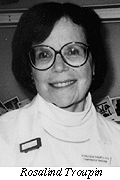 The Medical Student Government Teaching Awards are selected by nomination
by the graduating class for faculty who have demonstrated excellence in
teaching medical school classes. One recipient is selected from the basic
sciences and one from clinical medicine. This year's recipients are Helen
C. Davies, Ph.D., Professor of Microbiology, from basic sciences and
Rosalind H. Troupin, M.D., Professor of Radiology, from clinical
medicine.
The Medical Student Government Teaching Awards are selected by nomination
by the graduating class for faculty who have demonstrated excellence in
teaching medical school classes. One recipient is selected from the basic
sciences and one from clinical medicine. This year's recipients are Helen
C. Davies, Ph.D., Professor of Microbiology, from basic sciences and
Rosalind H. Troupin, M.D., Professor of Radiology, from clinical
medicine.
Almanac, Vol. 44, No. 30, April 21, 1998
FRONT PAGE | CONTENTS | JOB-OPS | CRIMESTATS | BETWEEN ISSUES | APRIL at PENN