| This year's Nobel Prize in Chemistry was awarded
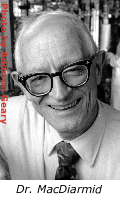
today to Dr. Alan G. MacDiarmid, Blanchard Professor of Chemistry at Penn,
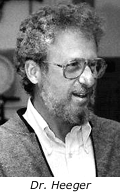
along with Dr. Alan J. Heeger, former Penn professor and director of LRSM,
now a professor of physics at UC Santa Barbara as well as Dr. Hideki Shirakawa
of the University of Tsukaba, Japan. The Royal Swedish Academy of Sciences
awarded the prize to the three scientists "for the discovery and development
of conductive polymers." They have "revolutionized the development
of electrically conductive polymers."
The Royal Academy announced that "Heeger,
MacDiarmid and Shirakawa made their seminal findings at the end of the
1970s and have subsequently developed conductive polymers into a research
field of great importance for chemists as well as physicists. The area
has also yielded important practical applications. Conductive plastics
are used in, or being developed industrially for, e.g. anti-static substances
for photographic film, shields for computer screen against electromagnetic
radiation and for "smart" windows (that can exclude sunlight).
In addition, semi-conductive polymers have recently been developed in light-emitting
diodes, solar cells and as displays in mobile telephones and mini-format
television screens.
Research on conductive polymers is also closely
related to the rapid development in molecular electronics. In the future
we will be able to produce transistors and other electronic components
consisting of individual molecules - which will dramatically increase the
speed and reduce the size of our computers. A computer corresponding to
what we now carry around in our bags would suddenly fit inside a watch"
As noted on Dr. MacDiarmid's homepage:
 Alan MacDiarmid,
co-discoverer of the field of conducting polymers, more commonly known
as "synthetic metals," was the chemist responsible in 1977 for
the chemical and electrochemical doping of polyacetylene, (CH)x, the "prototype"
conducting polymer, and the "rediscovery" of polyaniline, now
the foremost industrial conducting polymer. Alan MacDiarmid,
co-discoverer of the field of conducting polymers, more commonly known
as "synthetic metals," was the chemist responsible in 1977 for
the chemical and electrochemical doping of polyacetylene, (CH)x, the "prototype"
conducting polymer, and the "rediscovery" of polyaniline, now
the foremost industrial conducting polymer.
In 1973, he began research on (SN)x, an unusual
polymeric material with metallic conductivity. His interest in organic
conducting polymers began in 1975 when he was introduced to a new form
of polyacetylene by Dr. Hideki Shirakawa at the Tokyo Institute of Technology.
The ensuing collaboration between MacDiarmid, Shirakawa and Alan Heeger
(then at the Department of Physics at the University of Pennsylvania) led
to the historic discovery of metallic conductivity in an organic polymer.
This initial discovery and ensuing studies, in
collaboration with Shirakawa, resulted in the first chemical doping of
(CH)x and detailed physics studies with Heeger. That an organic polymer
could be readily doped to the metallic regime introduced a phenomenon,
completely new and unexpected to both the chemistry and physics communities.
This unleashed a flood-gate of research world-wide in chemistry and physics
concerning interrelationships between the chemistry, structure and electronic
properties of semiconducting and metallic organic polymers which has continued
to expand unabatedly to this day.
Technological opportunities for application of
these materials in such diverse areas as rechargeable batteries, electromagnetic
interference shielding, antistatic dissipation, stealth applications, corrosion
inhibition, flexible "plastic" transistors and electrodes, electroluminescent
polymer displays, to name but a few, continue to be actively pursued. |