ALMANAC BETWEEN ISSUES June 2, 2003
|
Bristol-Myers Squibb
Unrestricted
Research
Grants:
Dr. Lazar, for Metabolic Research and Dr. Lee for Neuroscience Research
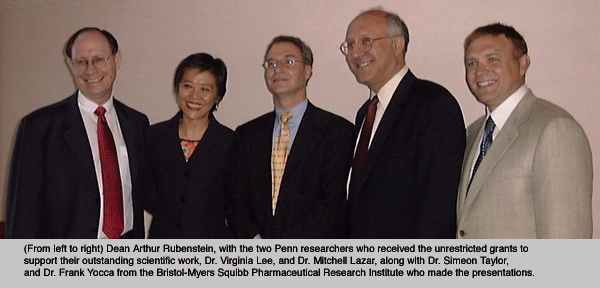
In a rare coincidence, two of the most coveted honors in biomedical research have been received by Penn researchers this year. It is believed to be the first time in the 26-year history of the Bristol-Myers Squibb Unrestricted Biomedical Research Grants Program for two winners in one year to be from the same institution. The two Penn School of Medicine researchers have each been awarded $500,000in no-strings attached grants from the Bristol-Myers Squibb Unrestricted Biomedical Research Program to support their work in the fields of metabolic and neuroscience research. At a ceremony on Friday, Dr. Mitchell A. Lazar, and Dr. Virginia M.-Y. Lee, each received a check for $500,000. The unrestricted nature of the grants allows researchers to put the support where it is most needed and gives scientists the freedom to pursue uncharted paths. Both researchers plan to use their unrestricted grants to further the research capabilities of their laboratories. "It is a wonderful honor for an institution to count a single recipient of a Bristol-Myers Squibb research grant among its faculty, let alone two such researchers honored in a single year," said Dr. Arthur H. Rubenstein, EVP of the University of Pennsylvania for the Health System and Dean of the School of Medicine. "Mitchell Lazar and Virginia Lee represent the spirit of medical science at Penn-they each excel at studying the basic molecular underpinnings of a disease, yet still manage to focus on translating their findings into medical practice." Dr. Lazar, professor of medicine and genetics, Chief of Endocrinology, Diabetes, and Metabolics, and Director of the Penn Diabetes Center, is an internationally known expert in nuclear hormone receptors and the regulation of gene transcription. His research grant will further support his groundbreaking research into hormone regulation of gene expression. Dr. Simeon Taylor, vice president, Hopewell Biology, Bristol-Myers Squibb Pharmaceutical Research Institute, in Princeton, presented a check to Dr. Lazar. "Dr. Lazar's research on the endocrine and metabolic aspects of gene regulation is highly regarded by scientists throughout the world, with implications even in the field of oncology research," said Dr. Taylor. "Recently, he has provided new insights into insulin resistance in type II diabetes and the relationship between obesity and diabetes. We are proud to welcome Dr. Lazar to the distinguished roster of scientists participating in our unrestricted metabolic research grants program."Dr. Lee, The John H. Ware 3rd Professor in Alzheimer's Research and Director of the Center for Neurodegenerative Disease Research, is a world leader in the field of Alzheimer's disease and dementias. Dr. Frank D. Yocca, executive director, Neuroscience Clinical Design and Evaluation, Bristol-Myers Squibb Pharmaceutical Research Institute, Princeton, presented a check to Dr. Lee. "Dr. Lee is clearly a world leader in the field of Alzheimer's disease and dementias," said Dr. Yocca. "Her discoveries in the biochemistry and pathophysiology of these diseases have contributed new understandings of how these diseases develop and progress. Dr. Lee adds an exciting new dimension to the work of scientists currently participating in our unrestricted neuroscience research grants program." The Bristol-Myers Squibb Unrestricted Biomedical Research Grants Program offers the world's premier research institutions the opportunity to pursue new clinical and laboratory findings, support promising young scientists, or acquire new laboratory technology-with no strings attached. Initiated in 1977, the Bristol-Myers Squibb Foundation has awarded unrestricted research grants to support research in the fields of cancer, cardiovascular diseases, infectious diseases, metabolic diseases, neuroscience and nutrition. Through the Bristol-Myers Squibb Unrestricted Biomedical Research Grants Program, the Foundation has committed over $100 million in support of 240 grants to 150 institutions in 22 countries worldwide. |
Posted 6/2/03